How Maye Musk Turns Age, Fear, and Experience into a Blueprint for Freedom
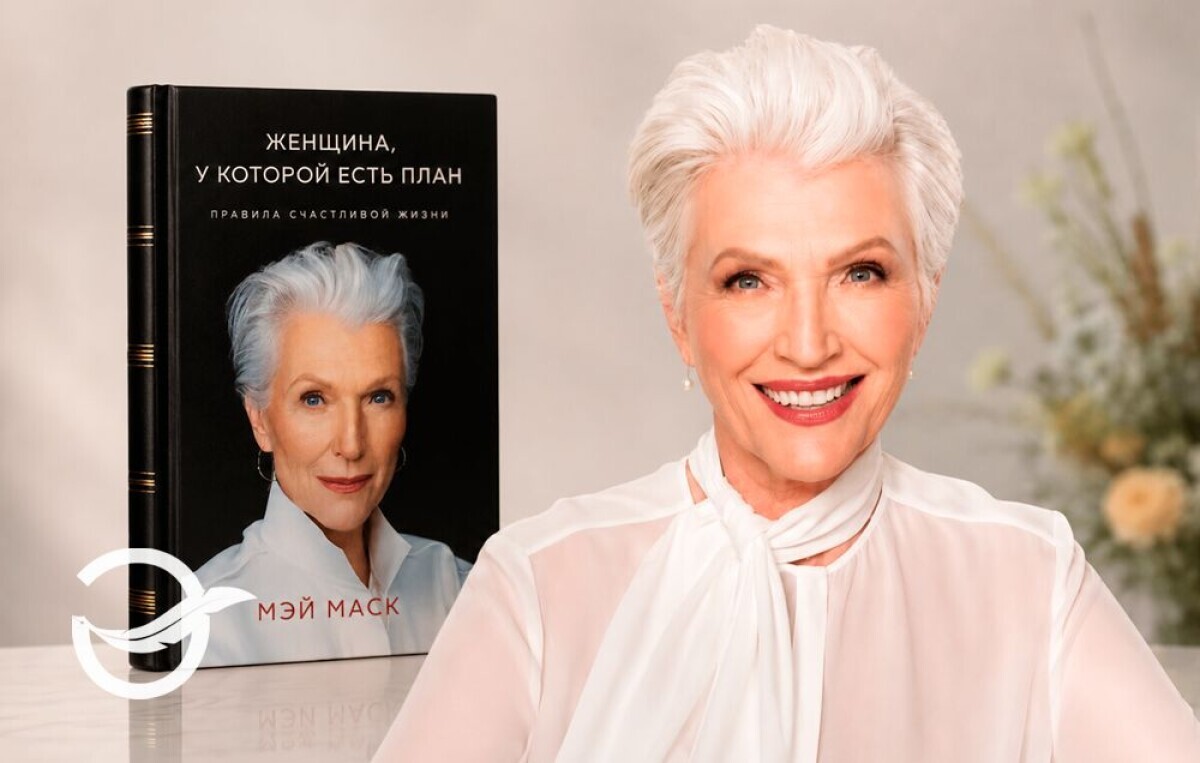
Sometimes, life does not demand grand heroism, but the simple capacity not to vanish. Not to break beautifully, not to suffer theatrically, not to constantly prove your strength to the world—but to simply wake up in the morning and decide: What can I do today? It is from these tiny, almost imperceptible choices that the inner resilience takes shape, the very foundation Maye Musk writes about in her book, A Woman Makes a Plan.
At first glance, the title sounds like the promise of yet another formula for success. It implies that somewhere within us lies a precise instruction manual: map out your goals, practice discipline, smile through the hardship, and life will inevitably fall into place. But Maye Musk’s book is wired differently. Her "plan" is not about maintaining flawless control over destiny. Rather, it is a way to avoid being overwhelmed by circumstances beyond your control. It is the habit of staying sane when you feel like giving up. It is the art of starting over—not because you are fearless, but because sometimes, there is simply no other choice.
To many, Maye Musk is known as a model, a nutritionist, a public figure, and the mother of Elon Musk. Yet, to perceive this book solely through the biography of her famous son would be deeply unfair. What lies before us is not a mere appendix to someone else’s glory, but the independent chronicle of a woman who lived several lifetimes within a single lifespan. A childhood in South Africa, a toxic marriage, divorce, poverty, raising three children, constant relocation, juggling multiple careers, a late-blooming professional peak, and finally, an age that became not her finale, but her finest stage.
Between Memoir and Compass
A Woman Makes a Plan sits at the crossroads of memoir, practical non-fiction, and an intimate conversation with the reader. It is not structured as a rigid autobiography where events march chronologically. Instead, it is a mosaic of life lessons, each carved out of concrete experience. Maye Musk speaks of beauty, family, career, health, aging, parenting, labor, and inner resilience. At times, her tone carries the weight of mentorship; at others, it feels like friendly advice, or the brief diary entry of someone who has survived enough to refuse to overdramatize the unnecessary.
The central question of the book could be framed as follows: How do you keep living when your old script has been shattered? Not how to become perfect. Not how to do it all. Not how to please everyone. But precisely—how to keep going. This is where its practical value lies. Maye Musk does not promise easy happiness, nor does she peddle the illusion of eternal youth, or pose as someone to whom everything came naturally. On the contrary, she constantly returns to the truth that much in life must be built by hand—with patience, labor, cautious courage, and the willingness to ask for help when you can no longer carry the weight alone.
One of the book's most powerful ideas is the reimagining of a "plan" not as a rigid grid, but as the agility to alter one's course. We usually think of a plan as a straight line: Point A to Point B, and the path between them. But Maye Musk’s life demonstrates that a real plan resembles an inner compass rather than a map. It does not avert the storm, but it guides you on where to steer when visibility drops to zero. For her, a plan is not a guarantee of success, but a survival tactic against being held hostage by chaos.
This perspective is profoundly essential in a culture where success is almost exclusively exhibited as a finished product. We see the magazine cover, the runway, the confident smile, the elegant silver hair, the public adulation. Yet behind it all lie years that refuse to fit into a glossy formula. Musk writes candidly about divorce, financial desperation, fear, and the necessity of working relentlessly, entirely stripped of romance. Her story is no fairy tale of a woman who simply got lucky. Rather, it reveals that "luck" often finds those who stubbornly and quietly show up to do their part of the work.
Reclaiming Time and the Dignity of Labor
The second vital thread of the book is her relationship with age. In contemporary society, aging is still largely treated as the gradual erasure of a woman from the visible sphere. Youth is commodified as a primary virtue, while maturity is treated as something to be concealed, softened, and camouflaged. Maye Musk offers a counter-narrative. Her silver hair becomes not a symbol of exhaustion, but a badge of presence. She does not try to look as though time never touched her; instead, she makes time an integral part of her aesthetic.
It is here that the book rings exceptionally true. Musk does not intellectualize age from a distance, nor does she lecture on self-acceptance. She simply demonstrates that one can be visible, professional, beautiful, vibrant, and sought-after far beyond the boundaries society has deemed "late." Her late-career renaissance matters not just as personal triumph, but as a gentle yet defiant rebellion against the notion that a woman’s social currency comes with an expiration date.
Yet, she does not romanticize aging into an artificial celebration. You will find no naive platitudes like "age is just a number" here. Age is more than a number. It is a physical body, an accumulation of experience, fatigue, memory, limitations, and shifts. But in Musk’s hands, it never reads as a verdict. She seems to say: Yes, time marches on, but that does not mean you must audition for your own disappearance. In this sense, her narrative speaks powerfully not only to older women but to a younger audience as well. It liberates the reader from the dread of the future, proving that life does not have to peak at twenty-five or thirty to be deemed fulfilled.
A third pillar of her philosophy is work as a source of dignity. Maye Musk writes about work stripped of any romantic haze. To her, labor is not merely a ladder to success, but a crucible for self-preservation. In the wake of her divorce, amidst brutal instability, with three children to support and a career to rebuild from scratch, work was not a beautiful slogan—it was survival. Here, the author is brutally honest: independence does not arrive unbidden. It is paid for in time, exhaustion, discipline, the sacrifice of luxuries, and relentless forward momentum.
This work ethic can occasionally border on the severe. Musk leaves virtually no room for self-pity. Her doctrine is simple: act, try, work, seek opportunity, do not wait for ideal conditions. Yet within this very hardness lies the raw truth of someone who once literally had no time for existential stalling. Her prose carries no sheltered, academic confidence; it bears the grit of a woman who knows the exact, steep price of dependency.
Boundaries in Parenting and Wellness
The theme of parenting is unpacked with particular nuance. Maye Musk refuses to wrap motherhood in a shroud of martyrdom. She does not paint the mother as an entity meant to dissolve entirely into her children. Instead, her stance is remarkably grounded: children must be granted autonomy, their unique interests must be noticed and supported, but their lives should not be lived for them. This thought feels rudimentary, yet it holds immense internal freedom. Love, in Musk’s world, is neither control, nor anxious micromanagement, nor the imposition of a script; it is a profound trust in the child's capacity to become themselves.
It is in these chapters that the book transcends personal anecdote and touches upon a broader malaise: how frequently adults mistake control for care. In our desperation to shield our children from mistakes, we stealthily rob them of their right to their own path. Maye Musk models an alternative: a parent who stands beside, not instead of; who helps, but does not suffocate; who believes, but does not program. Perhaps this is why her reflections on family feel so alive, utterly devoid of cheap sentimentality.
Another vital dimension of the book centers on health and nutrition. As a professional dietitian, Musk writes with authority, yet entirely free of mysticism. She is visibly allergic to the culture of miracle cures, crash diets, and magic pills. Her approach is thoroughly down-to-earth: real food, movement, routine, moderation, and common sense. There is an almost old-fashioned simplicity to it, which today reads like an act of political resistance. We live in an era where body care is twisted either into a cult or a punishment. Maye Musk restores wellness to human proportions: the body should not be tortured for the sake of an ideal; it must be negotiated with for the sake of life.
The Power of Understatement and Room for Critique
What struck me most about this book was not the author's ability to inspire, but her capacity to avoid overloading her pain with pathos. Her biography contains dark, heavy pages: domestic abuse, financial precarity, terror, loneliness, and the grueling necessity of hitting reset. Yet she refuses to monetize her trauma as the primary capital of her story. She discusses the agonizing moments calmly—sometimes even too calmly. Paradoxically, this makes the text cut deeper. Beneath the brisk, business-like exterior, the true depth of what she endured suddenly bleeds through.
There is a distinct literary ethics to this restraint. Maye Musk does not beg for the reader's pity; she abdicates the role of the victim from the outset. But this does not mean the pain evaporates. It simply yields the center stage. The center becomes the movement after the pain. And this is arguably one of the book's greatest virtues. It serves as a stark reminder: a human being is not obligated to reside forever at the place where they were once hurt.
Nevertheless, one can—and should—argue with Maye Musk. Her unshakeable faith in discipline, labor, and personal accountability commands respect, but it occasionally sounds too universalized. Not everyone is dealt the same opening hand. Not everyone possesses the health, the support systems, the education, the vital energy, or the access to opportunities. When a powerful individual insists there is always a way out, it can be comforting. But if codified into an absolute law, that thought turns treacherous, implying that anyone who failed to escape simply did not try hard enough.
Thus, it is best to read this book not as an obligatory blueprint for the masses, but as the testament of a single, formidable life. It offers no universal recipe for happiness—and perhaps that is a merit. Universal recipes are rarely honest. What is far more valuable here is witnessing how a specific woman, trapped in specific circumstances, navigated the terrain to keep from losing her soul. Some of her insights can be adopted, some contested, and some left entirely to her. Yet the energy of the book, its clear-eyed optimism, and its refusal to view age as a prison sentence, genuinely resonate.
Furthermore, there are moments where the narrative lacks the depth of social and historical context. Musk writes of her journey as a personal epic of overcoming, leaving certain systemic realities on the periphery. For instance, the nuances of living in South Africa, questions of privilege, social status, and the specific environment that molded her could have been parsed with greater depth. While this does not erase her personal hardships or cheapen her suffering, the reader occasionally longs for a wider analytical lens. Where the author is fiercely convincing in her self-reflection, she sometimes lacks the desire to look outward at the system, the era, and society at large.
Genre-wise, the book is a hybrid creature. It shifts from memoir fragments and career advice to nutrition notes, beauty musings, and family vignettes. For some readers, this fragmentation will be a strength: the text breathes easily, pivots quickly, and never exhausts. For others, it will register as a flaw—certain threads cry out for elaboration, demanding more space to linger, particularly the most dramatic ones. At times, Maye Musk turns her pain into a lesson too quickly. And the reader is left craving not just the conclusion, but the pause.
Images That Linger
The prose is simple, transparent, and conversational. You will find no intricate architecture, no exquisite metaphors, or the delicate psychology of high literature. But one should not seek artistic extravagance here. Its power lies elsewhere: the close fit between anecdote and lesson. Maye Musk narrates an episode from her life, then extracts a sharp, practical thought. Sometimes it lands bluntly, sometimes almost aphoristically, but more often than not, it works. The book reads effortlessly because the author does not hide behind dense semantics. She writes as though she is speaking to someone who, right now, desperately needs to pull themselves together.
Consequently, what lingers in the memory is not the laundry list of advice, but the imagery: a silver-haired woman who does not fade out of the fashion industry, but re-enters it on her own terms; a mother who refuses to turn her children into projects for her own vanity; a young divorcée forced to hold the line; a professional who keeps grinding while recognition is still a distant mirage; a human being unashamed of her years, because she walked a very long road to earn the right to be herself.
Who is this book for? It is for those weary of loud, aggressive self-help but who still hunger for human solidarity. For those navigating a season of upheaval, wondering how to piece their lives back together. For those terrified of aging, of divorce, of professional bankruptcy, or a late start. For those conditioned to believe that if something was not achieved on schedule, it is simply too late. Maye Musk’s book gently breaks that spell. It suggests that "late" is not always the end of the road. Sometimes, "late" is simply a different beginning.
It holds particular potency for women who have spent a lifetime existing in a state of suspended animation: waiting for the children to grow up, for life to quiet down, for money to appear, for someone to grant permission, or for the fear to dissolve. Maye Musk proves that the fear may never leave. But you can pack it up and move forward with it. And that, arguably, is her ultimate lesson. Courage here does not look like the absence of doubt. Courage is when the doubts are fully present, yet you refuse to let them become the masters of your life.
I appreciate that the book contains no aggressive mandate to become the "best version of yourself." That phrase has long since devolved into something too convenient and too cruel. Maye Musk invites you not to become someone else, but to refuse to abandon who you are. Not to eradicate weakness, but to learn to live in such a way that weakness does not steer the ship. Not to defeat age, but to cease viewing it as the enemy. Not to invent a flawless life, but to construct a sufficiently resilient one.
The final impression the book leaves is far quieter than what one might expect from the history of a high-profile, glamorous icon. It does not ignite a frantic urge to rewrite your yearly goals or trigger a radical life overhaul come Monday morning. Instead, it leaves you with a different realization: life does not have to be smooth, early, or faultless to possess meaning. You are allowed to blunder, to uproot your life, to start late, to lose your footing, to work again, to learn again, and to step back out into the light. You do not need a flawless script to possess an internal, unshakeable order.
A Woman Makes a Plan is neither a monumental literary confession nor a profound philosophical treatise. It is an honest, occasionally debatable, but vibrantly alive meditation on practical resilience. Its true worth lies not in explaining life definitively, but in reminding people that they can still act even without clarity. A plan, in Maye Musk’s universe, is not designed to abolish the chaos. It is designed so that you do not surrender yourself to the chaos entirely.