Into the ravine: reading Nurzhan Quantaiuly’s Qaraozek
778
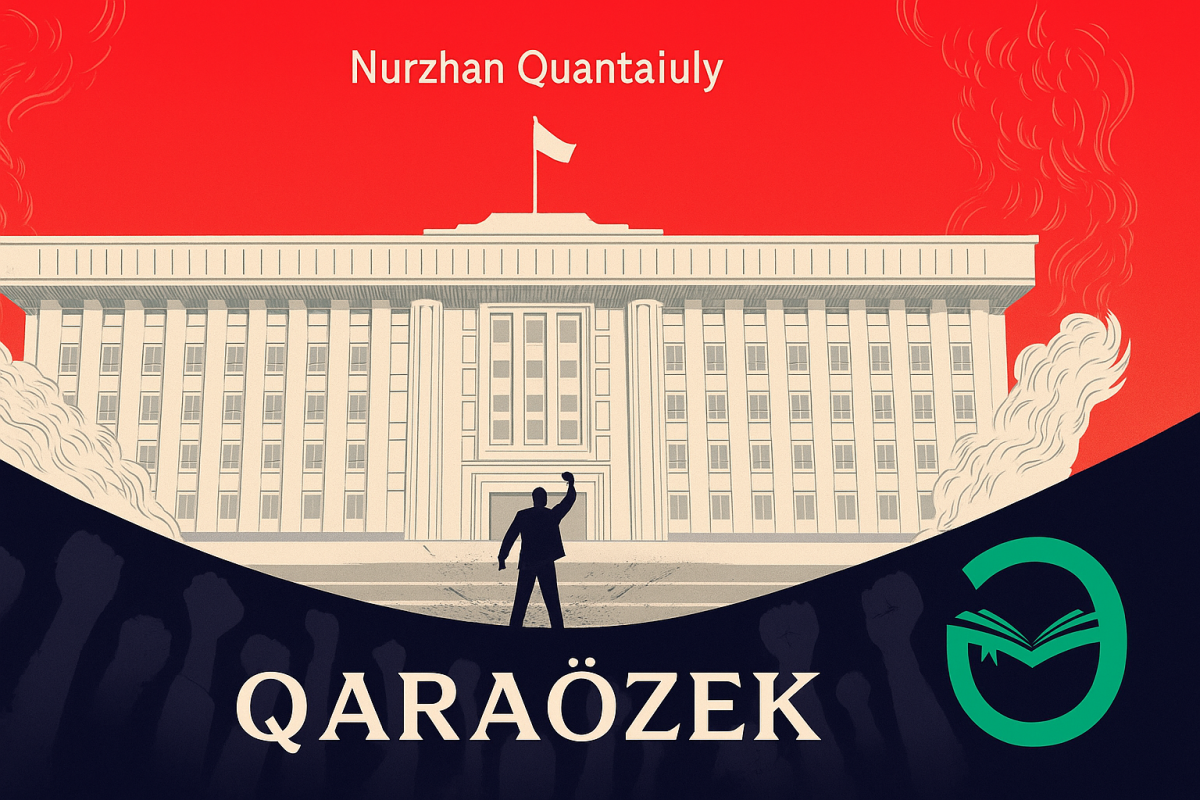
When Qaraozek (The Black Ravine) was published in 2002 by Qalamger, it immediately sparked interest as one of the first post-independence novels to examine Kazakhstan’s painful passage from Soviet repression into the harsh realities of freedom. Its author, Nurzhan Quantaiuly, is known as both a poet and a prose writer, as well as a literary scholar, and with this book he cemented his reputation as one of the most unflinching voices of contemporary Kazakh literature.
The novel takes as its starting point the December 1986 protests in Almaty, the pivotal event when thousands of young people poured into the streets to demand dignity and a future free from Moscow’s dictates. Quantaiuly’s protagonist, Khaknazar, is one of those students. Like so many in real life, he is punished mercilessly: arrested, convicted, and sent to prison. The years he spends behind bars become the crucible that shapes him, scarring him yet leaving him alive, to emerge in the early 1990s into a country that has changed beyond recognition.
This is where the true weight of Qaraozek begins. Independence has been declared, but the promise of freedom is undermined by the chaos of transition. Khaknazar finds work at the bazaar, rubbing shoulders with a new class of survivors–traders, hustlers, those trying to reinvent themselves in an unforgiving market economy. His struggle to adapt, to reconcile his ideals with the demands of daily survival, becomes a reflection of the dilemmas faced by a generation of Kazakhs caught between the ruins of the old order and the ambiguities of the new.
Quantaiuly peoples this landscape with a cast of supporting figures that embody the fractures of the time. Aldonggar, a fellow prisoner unjustly convicted, stands as a symbol of solidarity and shared suffering. Others–bazaar sellers, police officers, officials–represent the harsh pragmatism of the 1990s. Critics have noted that the novel’s characters are not romanticized or polished into archetypes. Instead, they remain contradictory, raw, vulnerable. In their weakness as well as their resilience, they embody the moral confusion of an entire society searching for direction.
Much has been written about the novel’s language and style. Unlike earlier works that sometimes wrapped historical trauma in patriotic rhetoric, Qaraozek strips away slogans and avoids easy moralizing. As reviewers on the Kazakh literary platform Adebiportal noted, there are no triumphant speeches about independence, no lyrical celebrations of national awakening. Instead, Quantaiuly uses a restrained, pared-down prose, letting silence and small details speak volumes. The result is a novel that critics have described as “tearing off the masks of our complex present, exposing bitter truths without embellishment.” It is precisely this refusal to decorate or romanticize that gives the book its power.
The symbolism of the title reinforces this bleak honesty. A “Qaraozek ,” literally “black ravine,” suggests entrapment, darkness, and absence of escape. It is a place where light is scarce and survival is uncertain. For Khaknazar, it is the gulf between his youthful ideals and his stark reality. For readers, it becomes a metaphor for the transitional decade of the 1990s–a void that the nation had to cross, often blindly, with no guarantees of what lay on the other side.
Of course, no novel is without its imperfections. Some readers have remarked that the pacing slows at times, particularly in sections heavy with description, and that not all secondary characters receive equal development. Yet these are minor flaws when weighed against the book’s broader achievement. What matters is that Quantaiuly dared to confront the shadow side of independence, a subject that in the early 2000s was still sensitive and often avoided. By giving voice to disillusionment as well as hope, by focusing on the broken as well as the resilient, Qaraozek opened a space for Kazakh prose to grapple honestly with the costs of transition.
Two decades later, the novel has lost none of its relevance. The themes that pulse through Khaknazar’s journey–alienation, the search for dignity, the struggle between memory and survival–still resonate in a society negotiating the burdens of its Soviet past and the demands of a rapidly changing present. To read Qaraozek today is to be reminded that independence is not merely a political declaration but an ongoing process, fraught with setbacks, compromises, and human costs.
As a piece of literary craft, Qaraozek belongs firmly within the tradition of social realism, yet it expands that tradition by introducing psychological depth and refusing to fall back on clichés. Its realism is not only external–depicting the bazaars, the prisons, the grim apartments of the 1990s–but also internal, showing the conflicts and fractures inside the minds of its characters. The absence of rhetorical flourish is not a weakness but a choice: by stripping away the noise, Quantaiuly forces the reader to confront the silence of trauma, the quiet exhaustion of people living through upheaval.
In the canon of post-independence Kazakh literature, Qaraozek occupies a special place. It is not a celebratory anthem but a stark elegy. It does not glorify resistance or romanticize freedom, but it does something more enduring: it bears witness. That witness is as valuable now as it was at the time of publication. For younger readers who did not live through the 1980s and 1990s, the novel offers an unflinching window into the uncertainties of their parents’ generation. For those who did live through it, it affirms experiences often left unspoken, confirming that their hardships and confusions were not isolated but part of a wider story.
Ultimately, Qaraozek endures because it is not content with offering easy answers. It challenges readers to ask difficult questions about justice, responsibility, and the costs of freedom. In doing so, it secures its place as a landmark of modern Kazakh prose, a mirror held up to an era when ideals were tested, and a testament to the resilience demanded by history.