Stillness in the age of noise: Krasznahorkai’s Nobel moment
1126
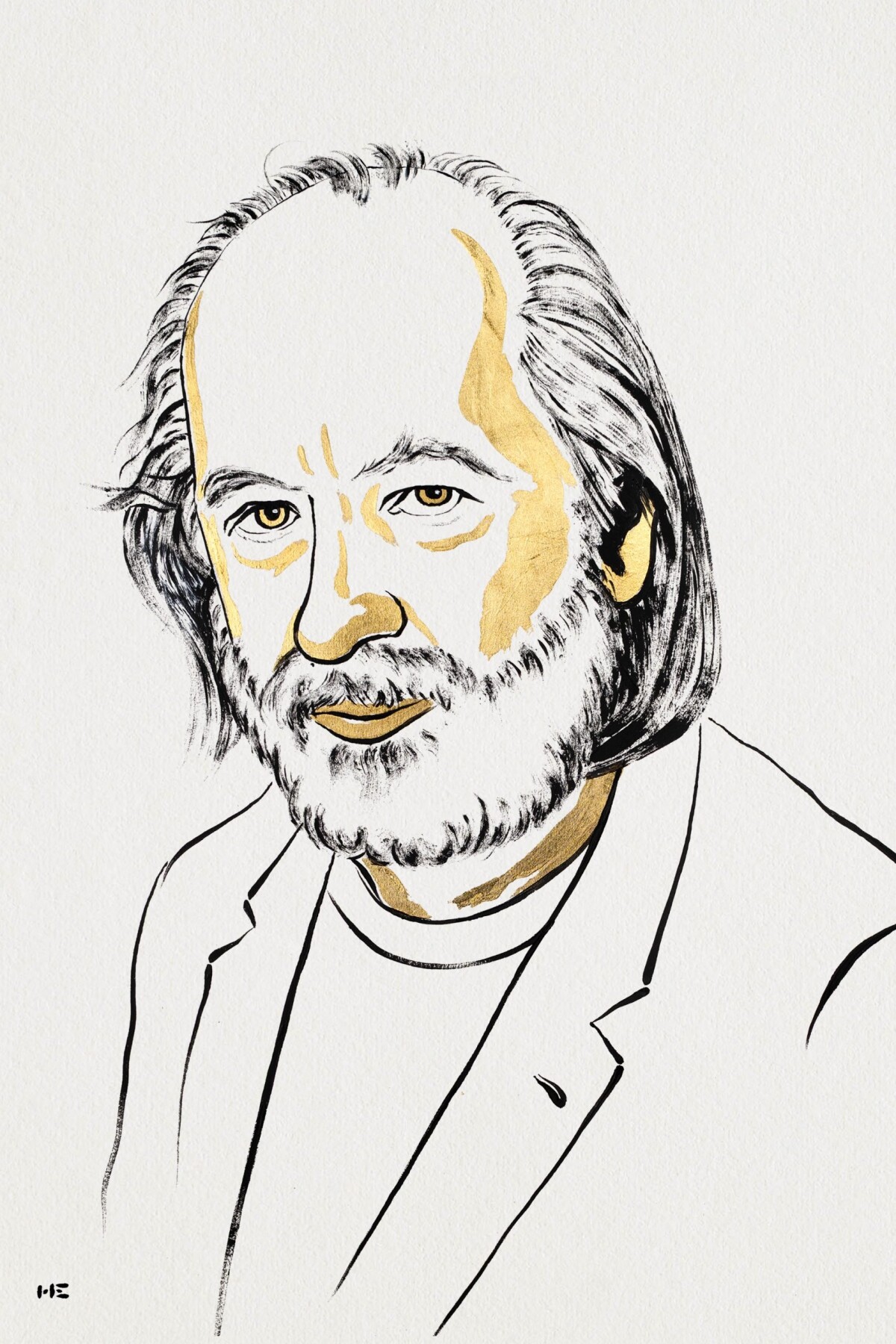
Ill. Niklas Elmehed © Nobel Prize Outreach
On a crisp October day in Stockholm, the Permanent Secretary of the Swedish Academy stepped up to the gilded podium and announced the 2025 Nobel Prize in Literature. The name rang out like a dark horse triumph: László Krasznahorkai. The 71-year-old Hungarian novelist was honored, according to the official citation, “for his compelling and visionary oeuvre that, in the midst of apocalyptic terror, reaffirms the power of art”.
It was a startling yet fitting choice. Krasznahorkai is hardly a household name, but among contemporary literature lovers he has long been revered –Susan Sontag once lauded him as the “contemporary master of the Apocalypse”. His win this October felt like more than just a personal accolade. In a world addicted to speed and digital noise, the Nobel committee’s decision came across as a quiet victory for stillness, depth, and the slow unfurling of meaning.
Who is László Krasznahorkai?
For those unfamiliar with him, Krasznahorkai’s Nobel nod raised an obvious question: just who is this writer with the formidable name, and what kind of books does he write? Born in 1954 in the town of Gyula, Hungary, Krasznahorkai emerged in the 1980s as a singular voice behind the Iron Curtain. His 1985 debut novel, Sátántangó, quickly became a cult classic at home. Set on a decrepit collective farm in the waning days of Hungarian communism, Sátántangó follows the members of a small, rain-soaked village as they pin their hopes on the return of a charismatic con man. Readers in 1980s Hungary immediately grasped the parallels between the novel’s isolated, stagnating rural community and their own society’s moribund state. Despite (or because of) its bleakness, the book struck a nerve. It was later adapted into an infamous seven-hour film by Hungarian director Béla Tarr, cementing its status as a modern classic of “slow” art.
Krasznahorkai’s international breakthrough came with The Melancholy of Resistance (1989), an uncanny fable about a mysterious traveling circus that rolls into a provincial town carrying the colossal body of a whale. The novel’s surreal premise – a giant whale corpse exhibited in the town square – sets the stage for a dark parable of chaos and inertia. There is a rumbling sense of dread as a mob forms and violence erupts under the influence of a sinister figure known as the Prince. Yet amid the madness, Krasznahorkai finds grim humor and absurdity. (The Melancholy of Resistance would later inspire Tarr’s film Werckmeister Harmonies, bringing its slow-burning eeriness to the screen.)*
Another of Krasznahorkai’s celebrated works is Seiobo There Below (2008), a novel that ventures far beyond Hungary to explore the search for the sublime in art and life. It unfolds in a series of vignettes spanning different eras and cultures, from a Japanese Noh theater master to a Renaissance painter. A thematic thread binds the episodes together: the longing for transcendence in a turbulent world. In one especially arresting scene, a snow-white heron stands motionless in the middle of Kyoto’s Kamo River, waiting to spear a fish – an image of perfect stillness amidst ceaseless motion. Such moments capture Krasznahorkai’s unique preoccupations. Over four decades, he has published more than twenty books, including the recent novels Baron Wenckheim’s Homecoming (a 2016 tale of a shabby aristocrat’s return to a corrupt hometown) and Herscht 07769 (a 2021 story composed as a single 400-page sentence). Now, with the Nobel Prize, he joins the pantheon of literature laureates – the first Hungarian to do so since Imre Kertész in 2002.
Apocalyptic visions and endless sentences
Krasznahorkai’s Nobel citation invokes “apocalyptic terror,” and indeed his fiction often stares unblinkingly into the abyss. He has been called a “master of the apocalypse,” but it is an apocalypse experienced in slow motion, through the eyes of ordinary souls. Critics have long noted the uneasy sense of impending doom that pervades his novels – James Wood memorably wrote that entering a Krasznahorkai story is like approaching a circle of people warming their hands at an invisible fire, “teetering on the edge of a revelation that is always imminent but concealed”. In Krasznahorkai’s world, history feels circular, conspiracies and false hopes abound, and the ground beneath reality always seems about to give way. Yet if this sounds unrelentingly grim, it’s only half the picture. His work is also shot through with irony, absurd humor, and moments of bizarre, mordant comedy. One Hungarian literature scholar notes that Krasznahorkai’s novels probe the “utter hopelessness” of human existence while simultaneously being “incredibly funny”. This blend of darkness and dark wit recalls forebears like Kafka or Beckett, but Krasznahorkai has a style all his own – one that the Nobel committee praised for its “absurdism and grotesque excess”.
Central to that style are his formidable sentences. Krasznahorkai is famous (some would say infamous) for crafting sentences that spool out for page after page, clause piled upon clause, sometimes without a single full stop. In fact, Herscht 07769, published in Hungarian in 2021, contains only one period in its entire 400 pages. These winding, clause-heavy constructions force the reader into a state of heightened concentration. At first blush, such an approach sounds daunting – a kind of literary endurance test. One commentator even quipped that Krasznahorkai’s prose is the “Hotel California” of literature: once you check in, “you can never leave”. Yet the payoff of these labyrinthine sentences is a uniquely immersive reading experience. The language swirls and flows like a current, pulling the reader into the same unstoppable momentum as the characters. Plots in his novels rarely follow a tidy linear trajectory; instead they circle, stall, and recur, mirroring the trapped, relentless feeling his characters often have. The pacing is deliberately slow, full of digressions and dense descriptions, which intensifies the atmosphere of existential suspense.
Paradoxically, many readers find Krasznahorkai’s work invigorating rather than enervating. The very length of his sentences creates a rhythmic, hypnotic drive. As one reviewer observed, those never-ending sentences, for all their alienation, can also shake readers out of complacency by propelling them “forever forward, phrase into phrase, image into image”. In other words, the style that initially feels challenging ends up being deeply absorbing. It places the reader inside an almost claustrophobic consciousness – whether that of a drunken village doctor obsessively observing his neighbors (as in Sátántangó), or a musicologist losing his mind in the pursuit of an ideal tuning, or a desperate archivist convinced the world is about to end. Krasznahorkai often populates his novels with visionary obsessives and holy fools: people who pursue meaning at the very edge of madness. Through their quests, the books grapple with grand philosophical questions: Is there order beneath chaos? Where can one find the sacred in a collapsing world? Despite the feverish intensity of his prose, there is a spiritual undercurrent to Krasznahorkai’s oeuvre – a sense of reaching for transcendence amid rubble. It’s this blend of apocalyptic imagination and metaphysical depth that makes his writing so distinctive. As bleak as his fictional universes can be, they are not hermetically sealed or nihilistic. They reaffirm, to quote the Nobel committee, the power of art and imagination even “in the midst of apocalyptic terror”.
A Nobel for a fast-paced world
At first glance, Krasznahorkai might seem an unconventional Nobel laureate. His experimental, demanding style is miles away from the accessible lucidity that Nobel judges have sometimes favored. Yet, as The Atlantic noted, in today’s unstable world his selection feels “perfectly timely”. Why? Because Krasznahorkai’s work resonates powerfully with the current cultural moment – almost in spite of itself. In an era of tweets and TikToks, when entertainment and information flash by in an eyeblink, here is an author who forces us to slow our reading to a crawl. His Nobel win is significant precisely because it highlights the value of slowness and deep attention in a time of digital saturation. Amid widespread fears that our collective attention span is shrinking, some critics have advocated for a return to “slow reading” – the kind of immersive, patient engagement that lengthy literature demands. As one Guardian essay put it: we should stop skimming and rediscover slow reading, because it is “rich in rewards”. Krasznahorkai’s novels embody those rewards. They insist on a kind of mindfulness from the reader, a willingness to absorb complex sentences and silence the urge to click away. By honoring him, the Nobel committee tacitly affirmed that such quiet, intensive literary experiences still matter. In our hyperactive, fast-content culture, this award came as a gentle rebuttal: literature, at its best, isn’t a sprint – it’s a slow, endless dance.
Beyond the contrast with digital culture, Krasznahorkai’s Nobel also speaks to the anxieties of our age. The official prize motivation references “apocalyptic terror,” a phrase that feels eerily apt in 2025. We are living through a time of looming global crises – from climate change and environmental collapse to pandemics and political upheavals – that often carry an apocalyptic tenor. Krasznahorkai’s fiction has long dwelled in such end-of-the-world atmospheres. His characters inhabit landscapes of decay, corruption and slow catastrophe, whether it’s a village crumbling from within or a world on the brink of war. This Nobel nod suggests that the Swedish Academy sees value in confronting those fears head-on. Yet importantly, they chose to emphasize not the terror alone but the redemptive role of art. In the words of the Nobel press release, Krasznahorkai’s oeuvre “reaffirms the power of art” amidst the darkness. There’s a hopeful undertone to that message. It tells us that even as we face very real apocalyptic threats – melting ice caps, mass extinctions, social unraveling – we have not lost faith in the capacity of art and storytelling to help make sense of it all. Krasznahorkai’s win, then, is not only a recognition of a lifetime of literary achievement; it’s a symbolic reminder that slowness, reflection, and imagination are not luxuries but essentials, especially in turbulent times. His slow apocalypse-style of fiction feels strangely right for a slow-motion crisis era. By reading his stories of collapse and perseverance, we might learn something about enduring our own. As Krasznahorkai himself has suggested, engaging with literature and fantasy can give us “more power to survive these very, very difficult times on Earth”.
Stillness and the future of literature
When informed of his Nobel Prize, László Krasznahorkai was characteristically humble – and a touch wry. “I cannot believe that I’m a Nobel Prize winner,” he told an interviewer, admitting he was “absolutely surprised” by the honor. He even joked by invoking Samuel Beckett’s famous one-liner about the Nobel (“What a catastrophe”). But Krasznahorkai also used the moment to reflect on why literature matters. In the same interview he offered a hopeful wish: “I wish for everybody to get back the ability to use their fantasy… Without fantasy, it’s an absolute different life. To read books… gives us more power to survive these very, very difficult times on Earth”. This conviction, coming from an author who has spent a career exploring humanity’s darkest corridors, is inspiring. It suggests that even the “master of the Apocalypse” sees literature as a lifeline – a source of resilience and meaning when the world feels unmoored.
Krasznahorkai’s Nobel Prize is a testament to the continued relevance of challenging, profoundly unhurried literature in our present and future. It sends a signal that the literary world still values those writers who dare to take their time, both in style and substance. As we look ahead, the question arises: what does this recognition tell us about where literature is headed? Perhaps it tells us that even as technology races forward, there is a countercurrent pulling readers back toward the timeless act of quiet reading. Perhaps it tells us that, in an era of noise, a certain segment of the culture is craving silence – or at least the kind of layered, contemplative storytelling that Krasznahorkai exemplifies.
Ultimately, Krasznahorkai’s Nobel win affirms that the art of stillness is very much alive. His slow, spiraling novels remind us that some truths can only be reached by moving at the pace of thought, or of prayer – certainly at a pace much slower than the internet. In recognizing him, the Nobel committee has highlighted a path forward for literature that doesn’t compete on the terrain of instant gratification, but rather offers an antidote to it. The future of literature, if Krasznahorkai’s victory is any indication, will continue to make room for writers who push us to pay attention, to grapple with difficult ideas, and to find moments of beauty in the midst of chaos. It’s a future where stillness isn’t a weakness but a strength. And in that stillness, as in Krasznahorkai’s entrancing prose, we might rediscover what it means to be fully human in a fraught and fragmenting world.