Pu Songling’s Strange Tales: Where Even Ghosts Are Bureaucrats
In Chinese literature, foxes turn into beautiful women, the dead take up government posts, and even the afterlife follows the rules of bureaucracy. This is the world of Pu Songling, author of the celebrated collection Strange Tales from a Chinese Studio. His fantastical stories explore more than spirits, shapeshifters, and supernatural phenomena. They also reveal how Chinese society functioned and how people understood justice, morality, and human destiny. Three centuries later, these tales have acquired new significance. As China's global influence grows, understanding the culture of Kazakhstan's largest neighbor becomes increasingly important.
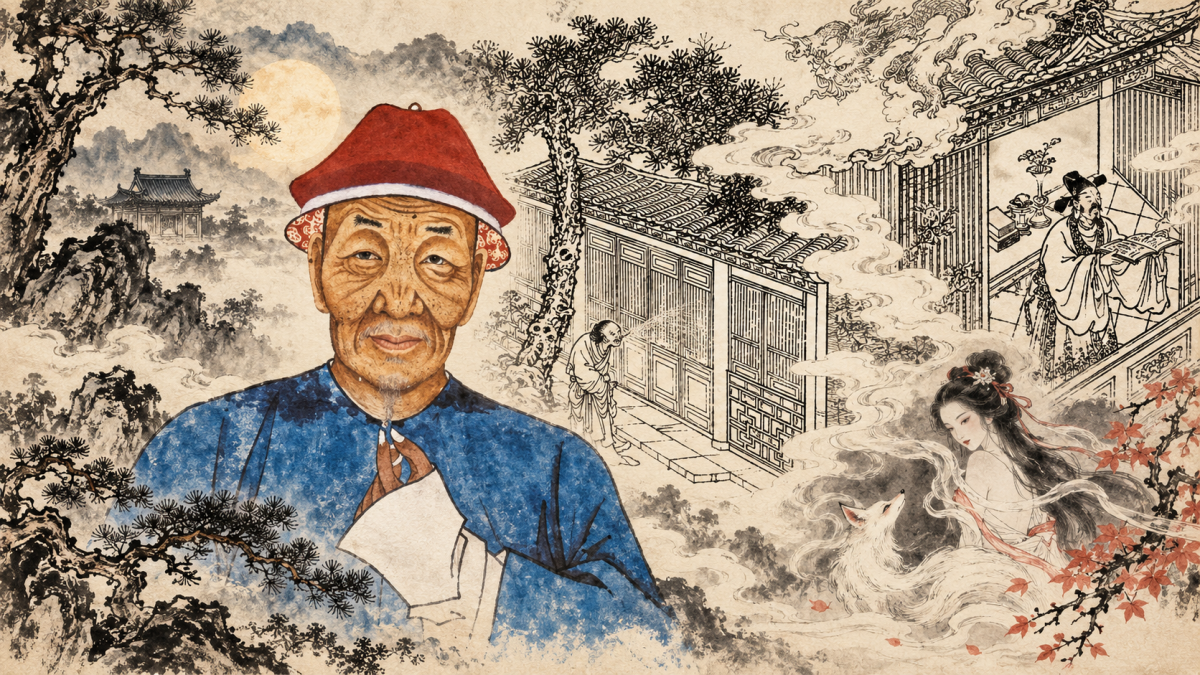
Pu Songling: The Writer Who Failed to Make the Grade
Strange Tales from a Chinese Studio, also known as Strange Tales from Liaozhai, is a collection of supernatural short stories by the Chinese writer Pu Songling. The work has also appeared under the title Fox Enchantments, although many of its stories have nothing to do with foxes. Pu Songling lived from 1640 to 1715, a period that coincided almost exactly with the lifetime and reign of Louis XIV. In Europe, this was the golden age of French absolutism. Around the time the young Louis was caught up in the turmoil of the Fronde, China was also experiencing wars and rebellions. The undercurrent of violence that runs through Pu Songling's stories, sometimes bursting dramatically to the surface, was therefore not simply a product of his imagination.
Yet the literary worlds of China and Europe at the time seem almost like different planets. In terms of structure, the collection can loosely be compared to One Thousand and One Nights. It is not a continuous narrative: there are no recurring protagonists or framing stories of the kind found in One Thousand and One Nights, where one tale is embedded within another. Instead, it is an extensive collection of independent stories, connected not by plot but by theme. Some feature officials and students, others peasants and small landowners, and still others spirits, shapeshifters, and creatures that exist beyond the human world.
Why, then, did this collection become so celebrated in China, and why is its author described as a failure? Much of the answer lies in the social environment in which Pu Songling lived. Liaozhai was the literary name associated with his study, a kind of authorial alter ego. The Studio of a Failure, or the Studio of Leisure, was a refuge for a man who had not succeeded in life. But what exactly had he hoped to achieve? The answer is straightforward: he had failed the examination that would have opened the way to a higher position in the government hierarchy.
China's bureaucratic system was ancient, intricate, sophisticated, and, at least in principle, based on meritocracy: advancement through demonstrated ability and achievement. Merit was assessed primarily through examinations. A Chinese scholar or student hoping to enter government service was expected to memorize an enormous body of classical literature. This included the teachings of Confucius, poetry, historical and philosophical works, and other canonical texts. All this knowledge had to be committed to memory, because the examinations tested not only a candidate's education but also his ability to draw upon centuries of cultural tradition.
Moreover, the language of these classical works differed considerably from everyday speech, even in Pu Songling's time. A scholar was expected to master a highly refined literary style, understand ancient writings, and incorporate them into his own compositions. Having acquired the necessary knowledge, he would sit an examination and either pass or fail. Preparation, failure, and repeated attempts could stretch over decades. The perpetual student who devoted his life to securing an official position was one of the characteristic figures of traditional China.
Pu Songling himself passed the initial examination but never managed to clear the more advanced provincial stage. His biography, like those of many Chinese writers, has been partly mythologized. Accounts of his life portray a man who gathered friends around him, admired nature, enjoyed conversation, and composed unusual stories that might initially seem frivolous. Yet the paradox is that this unsuccessful scholar possessed extraordinary literary erudition. His works are so densely packed with references to ancient Chinese culture that it is difficult to imagine how many texts he must have mastered to write them.
The World of Chinese Fantasy: Foxes, Ghosts, and Unfamiliar Morality
Most of the stories are set in the China of Pu Songling's own time, often in provincial surroundings he knew well. Yet everyday life constantly intersects with the supernatural. These are tales of spirits, ghosts, shapeshifters, and the famous foxes that assume human form, usually female but sometimes male, and interfere in people's lives. Some stories are frightening, others humorous, while still others are risqué or even indecent by the standards of readers raised on European literature. Certain tales end with a moral lesson that can be just as surprising as the supernatural events themselves.
On the surface, it all seems fairly straightforward. This is a collection of fairy tales, fables, and ghost stories in which supernatural forces intrude upon the lives of otherwise ordinary people. Pu Songling's favorite protagonist is a student, a minor official, or someone preparing for yet another examination. Sometimes he is a peasant, merchant, or landowner. Such characters inhabit a familiar, predictable world until they encounter a being that disrupts the established order. A beautiful woman may turn out to be a fox, a chance acquaintance may be a dead man, and an apparently insignificant incident may mark the beginning of an extraordinary adventure.
What makes these stories particularly fascinating is their approach to morality. At times, Liaozhai, the author's literary persona, follows the example of Charles Perrault and adds a moralité, a lesson intended to convey the meaning of the tale. Yet these conclusions often clash with modern readers' ideas about right and wrong, just punishment, and what exactly should be learned from a particular story. A character who initially appears virtuous may behave with shocking cruelty. Someone who violates conventional moral rules may nevertheless inspire sympathy. And the author's final judgment may be entirely different from what the reader expects.
Ancient Chinese mythology plays an important role here. Shapeshifting foxes, dragons, spirits of the dead, and vengeful ghosts returning from the underworld after improper burials had all existed in popular belief long before Pu Songling. Clearly, the writer did not invent every story from beginning to end. He drew on a rich body of folklore, transforming familiar plots into literary works. The result was a distinctive blend of popular culture and classical scholarship, the educated and the uneducated, ancient beliefs and a sophisticated literary tradition.
For educated Chinese readers, one of the greatest pleasures of these works lay in seeing lighthearted, sometimes bawdy folk tales presented not merely in an elevated style but through an intricate network of references to classical literature. A comparable technique in European literature is the cento, a composition assembled from passages taken from other works. A well-known example is a wedding poem by the late Roman poet Ausonius, who used lines from Virgil to create an entirely new and openly obscene work. The ingenuity of this technique lies in the reader's simultaneous awareness of two contexts. Readers recognize a classical quotation and remember its original setting, but now encounter it in an entirely different situation. This creates a sophisticated literary game, accessible above all to those familiar with the source material. Pu Songling's writing produces a similar effect. His fantastical stories can be enjoyed simply as extraordinary tales of supernatural events, but beneath their apparent simplicity lies an immense body of Chinese literary tradition.
Heavenly Bureaucracy: Why Officials Still Work After Death
Alongside stories about foxes and ghosts, Pu Songling's collection includes tales that reveal the structure of Chinese bureaucracy with remarkable clarity. Many of his characters are xiucai, educated men who spend years preparing for the imperial civil service examinations. They aspire to official appointments, recognition, and a secure place within a complex social hierarchy. What is remarkable, however, is not merely that ordinary human life operates according to these rules, but that the afterlife follows them as well.
One particularly revealing example is the story Wang Liulang (Sixth Brother Wang). It tells of a fisherman who one day meets a pleasant stranger. The two begin spending evenings together over drinks. Night after night, the new acquaintance keeps the fisherman company and, toward morning, somehow helps him fill his nets with fish. Gradually, a friendship develops between them, and everything goes well until the mysterious companion finally confesses that he is not actually alive. During his lifetime, he had been far from exemplary, and after his death he became a river spirit. He was perfectly content with his position and would have preferred to remain where he was, especially now that he had found a good friend. But his superiors in the afterlife had other plans. The spirit had performed his duties so well that he was promoted, although the promotion came with a transfer to another location. Having received a higher position, he was forced to leave his familiar surroundings behind.
This was precisely what happened to Chinese officials, who were regularly transferred from one part of the empire to another. One reason for the practice was to prevent officials from becoming too deeply entrenched in a single location, developing powerful personal connections, and creating opportunities for corruption. Government service required constant movement within the administrative system. And so it turns out that even death does not release a person from these rules. He continues to serve, receives promotions, and must obey the orders of his superiors.
The story does not end there. After assuming his new position, the spirit invites his fisherman friend to visit him in his new domain. He now occupies a higher rank in the hierarchy of the afterlife and possesses the authority that comes with it. In this way, a supernatural tale unexpectedly becomes a story about a bureaucratic career, except that its protagonists are no longer living people but inhabitants of the other world.
Equally fascinating are traditional Chinese ideas about prosperity after death. Whereas an ancient Egyptian might build himself a pyramid, a person in traditional China could provide for his existence beyond the grave in entirely different ways, such as accumulating savings in a bank in the afterlife. According to these beliefs, there could be several such banks, some considered more reliable than others. The very idea of money existing beyond earthly life is unusual enough, but the method of obtaining it is even more remarkable. A person would visit a temple, purchase special paper money, and burn it during a ritual. The belief was that the money would thereby be transferred to the afterlife, where the deceased could use it. This amounted to a transformation of real material resources into symbolic wealth that retained its value even after death. The afterlife was imagined not merely as a continuation of earthly existence but as a realm where familiar economic relationships remained intact.
All this reveals how deeply ideas of social hierarchy were embedded in the cultural consciousness of traditional China. The spirit world in these stories is modeled on earthly society. It has official positions, superiors, administrative duties, transfers, promotions, and accumulated wealth. Even death does not abolish the established rules. There is a peculiar comfort in this idea: a person dies, but the familiar order does not disappear. Life seems to begin anew within a recognizable system of relationships, where one can once again take examinations, undergo trials, seek advancement, and accumulate riches.
Forbidden Themes: Eroticism, Cruelty, and the Limits of Morality
Pu Songling's fantastical world, however, is not confined to stories about officials and the afterlife. His collection contains plenty of plots capable of surprising even modern readers. These involve eroticism, unconventional forms of human relationships, cruelty, and punishment. It would be misleading to describe this eroticism as innocent. Sometimes it is charming, sometimes unsettling, and occasionally downright horrifying. Nor are such episodes merely decorative elements of the narrative. Through them, the author explores his characters' desires, weaknesses, and actions.
One story, for example, concerns a woman whose husband was frequently away from home for extended periods. During his absences, she entered into an unnatural sexual relationship with an enormous white dog. The story ends in catastrophe, with punishment so severe that it seems almost more horrifying than the transgression itself. For readers accustomed to a recognizable sense of proportion between offense and punishment, the ending is particularly disturbing. It raises questions not only about the characters' behavior but also about the nature of justice, which in this instance appears far crueler than the violation it is meant to punish.
Another striking example is the story Huang Jiulang (Huang the Ninth). Its protagonist is attracted to a young man who initially rejects his advances. Gradually, the reason for these refusals becomes clear: the young man is concealing a secret. He is actually a fox spirit in human form. Pu Songling's shapeshifting foxes are not always women; some are men. Intimacy with such a creature proves dangerous and gradually destroys the protagonist. Yet even death does not bring the story to an end. He is reborn in another body, and the relationship continues with the same consequences. Later, the plot takes an even darker turn. The protagonist begins using the fox spirit's attractiveness against his own enemies, sending the shapeshifter to seduce them so that they, too, become victims of a deadly liaison. What begins as an unusual tale of forbidden desire becomes a story of obsession, revenge, and a person's willingness to use another being as an instrument of destruction.
Such stories significantly broaden our understanding of Pu Songling beyond the image of a writer who simply composed beautiful fairy tales about foxes. In his world, supernatural beings are not necessarily good or evil. They can seduce, help, deceive, rescue, and destroy. Human beings, meanwhile, can be both victims and perpetrators. Moral judgment often depends on circumstances that do not fit neatly into conventional distinctions between right and wrong.
Why Read Pu Songling Today?
At first glance, the question of why anyone today should read seventeenth-century Chinese fantasy stories seems a perfectly practical one. What can a book about spirits, foxes, and officials in the afterlife offer someone living in an entirely different era? Above all, Pu Songling's stories are compelling works of literature. Many of their plots are recognizable, echoing folk motifs found in different parts of the world. The youngest son unexpectedly finds happiness; a beautiful stranger becomes the hero's beloved, only for him to discover that she is not who she appears to be. In Scottish folklore, she might be a seal-woman; in Arab traditions, a heron-maiden; in Pu Songling's stories, a fox. Such transformations and encounters with supernatural beings are familiar features of the world's fairy-tale traditions.
Yet the Chinese writer develops these familiar plots in an entirely distinctive way. Just when readers believe they have worked out who is good, who is evil, how the story should end, and what moral lesson it will convey, the narrative unexpectedly changes direction. It is like looking through a clear pane of glass, only to discover that it is actually a kaleidoscope.
Today, however, reading Pu Songling also has another, more practical significance. Whether we like it or not, China is becoming an increasingly prominent presence in modern life. Its economic, technological, and political influence is evident not only in neighboring countries but also in many other regions of the world. Chinese companies, products, investments, infrastructure projects, and technologies have become integral to international relations. This reality is particularly important for Kazakhstan. China is the country's largest trading partner, with extensive economic, transport, and investment ties. Yet economic cooperation does not necessarily translate into a deep understanding of one another.
History, literature, and philosophy shape a society's distinctive ideas about power, social order, human dignity, duty, and justice. This is where older literary works acquire a significance that extends far beyond the pleasure of reading fiction. Pu Songling's collection is particularly interesting in this respect. His stories introduce readers to a cultural world in which government hierarchy extends even into the afterlife, education involves years of studying classical texts, and supernatural beings operate within a complex system of moral and social relationships. All this offers insight into some of the historical ideas that helped shape Chinese civilization. Of course, a book written three centuries ago cannot explain the motivations of every Chinese person today or the decisions of the modern Chinese state. It can, however, reveal the cultural foundations upon which certain social ideals and patterns of thought developed.
For Kazakhstan, such familiarity is especially valuable because its proximity to China entails constant interaction between two distinct historical and cultural traditions. Mutual understanding requires knowledge of how another society has interpreted its past, envisioned an ideal social order, identified the qualities worthy of respect, and confronted the contradictions within its own way of life. In this sense, literature can accomplish something that even detailed historical or political explanations do not always achieve. It reveals another culture from within, through stories, conflicts, human desires, and ideas about how people ought to behave. Familiar fairy-tale motifs help readers approach this unfamiliar world, while unexpected endings and unconventional moral reasoning remind them how different it can be from their own. And as China becomes an increasingly significant part of everyday international life, this kind of understanding grows more important, not only for Kazakhstan but for the entire world.
Strange Tales from a Chinese Studio is far more than a collection of fantastical stories about foxes, spirits, and supernatural events. Through extraordinary incidents, Pu Songling portrays a society in which power and bureaucratic hierarchy shape human destiny, classical education determines social standing, and ideas of morality and justice sometimes take unexpected forms. His stories entertain, surprise, and offer readers a glimpse into a different cultural reality.
In a world where China plays an increasingly prominent role, exploring its literary heritage is more than an intellectual pleasure. It offers an opportunity to better understand the history and worldview of a civilization with which Kazakhstan and the rest of the world will continue to interact. Perhaps this is Pu Songling's greatest achievement: rather than providing ready-made answers about China, he helps us question our confidence that we already understand it well enough.