Love, Bandits, and a Shocking Secret: The 1,700-Year-Old Novel That Still Feels Modern
Long before modern thrillers, sprawling adventure sagas, and love stories filled with impossible obstacles, an ancient Greek writer had already mastered the art of keeping readers hooked. His novel featured kidnappings, mistaken identities, dangerous journeys, forbidden love, human sacrifice, and a mystery whose solution was withheld for hundreds of pages. But Heliodorus’s Aethiopica is more than an entertaining relic of antiquity. It offers a fascinating glimpse into the birth of the European novel, the changing technology of books, and a surprisingly cosmopolitan ancient world. It also raises an intriguing question: how much of what we consider modern storytelling was already familiar nearly two thousand years ago?
Our book today takes us back to the ancient world we have been exploring. It is generally regarded as one of the earliest novels in the European literary tradition, although we will have to examine exactly why it deserves that designation. The work in question is Aethiopica, a Greek novel written by Heliodorus in the third century AD.
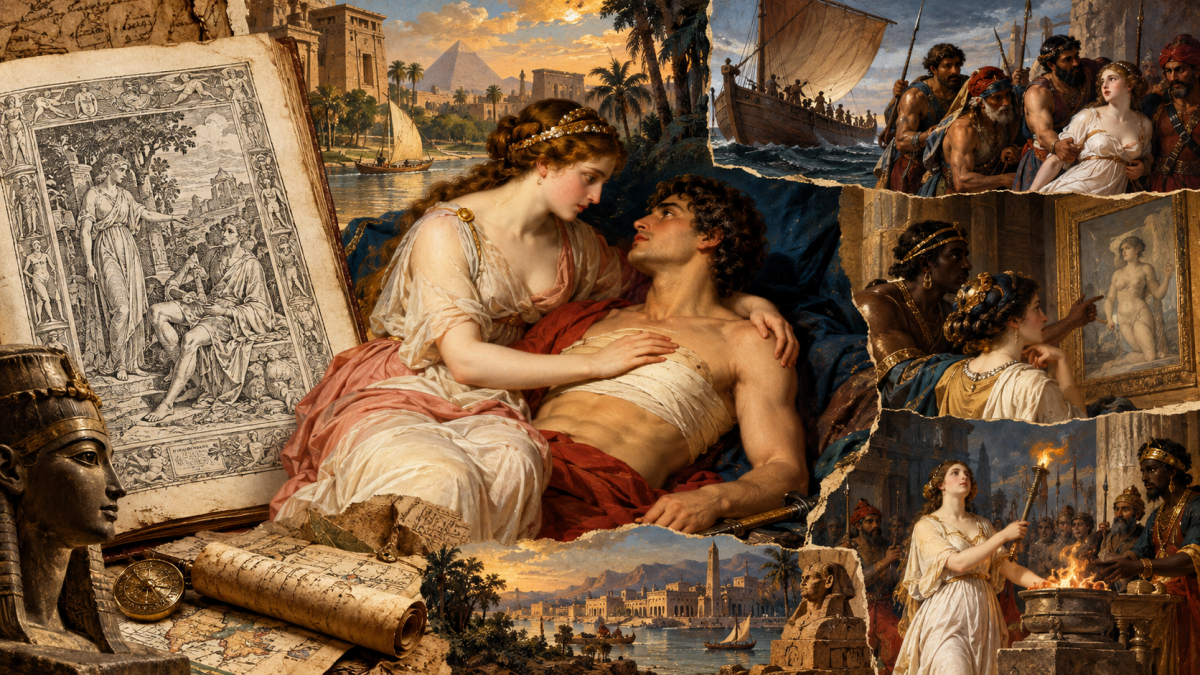
Heliodorus is worth discussing for several reasons. His story is genuinely entertaining, it is about love, and he is widely considered one of the pioneers of the novel as a literary form. Aethiopica is a prose narrative written in Greek, following the adventures of two young lovers who fall in love at first sight, only to be repeatedly separated by a seemingly malicious fate. They are kidnapped by bandits, threatened with human sacrifice, and caught up in all manner of mistaken identities. They travel across land and sea, encountering danger at every turn. Despite its title, which essentially means "An Ethiopian Story," Ethiopia is only the setting of the novel's conclusion. Most of the action takes place in Egypt, and not even in the Egypt of Heliodorus's own time. The author sets his story roughly eight hundred years in the past, in a legendary Egypt governed by a Persian satrap. This is not the Egypt of the Hellenistic period but a much older, more distant world.
In modern terms, we would call Aethiopica an entertaining romantic adventure. The main narrative is interrupted by shorter stories, digressions, and episodes devoted to such subjects as the origins of the Nile. Sometimes the author pauses to reflect on a particular question; elsewhere, characters recount the events of their earlier lives. In one sense, the book anticipates countless European novels about lovers kept apart by circumstances beyond their control. It also resembles the literary equivalent of a road movie: characters travel from place to place, meeting good people, villains, and everyone in between. This tradition would eventually flourish in the picaresque novels that became especially popular in the eighteenth century. Yet Aethiopica also has a distinctly Eastern atmosphere, at times recalling One Thousand and One Nights. Its protagonists are idealized, almost flawless lovers whose happiness is threatened entirely by external forces rather than their own psychological conflicts. It is not yet a psychological novel in the modern sense, although traces of psychological complexity can certainly be found.
Spoiler alert: everything ends happily, which only adds to the novel's fairy-tale quality.
The entire story is infused with an exotic, Eastern atmosphere. It unfolds across a vast world of seas, overland routes, and Egyptian tribes fighting over emerald mines and marshlands. At one point, a human sacrifice is being prepared. The Ethiopians practice human sacrifice, but only foreigners can become victims, and that distinction is important. In one of the final twists, the heroine's own father is expected to sacrifice her without realizing that she is his daughter. Why does he fail to recognize her? That is one of the novel's most dramatic revelations, and the explanation is deliberately withheld until much later in the story. Eventually, the Ethiopian king abolishes this barbaric practice, marking a kind of moral progress. Before that happens, however, his advisers acknowledge that sacrificing human beings is hardly appropriate in their enlightened age, while also insisting that even a king must sometimes submit to tradition. In other words, he should not take it upon himself to change established customs simply because he finds them objectionable. The people expect a sacrifice, so someone must be killed. The attitude is essentially, "We didn't start this tradition, so who are we to end it?" Fortunately, by the conclusion, they do end it.
Is It Really a Novel? Why the Ancient Greeks Never Named the Genre
Virtually every major genre of Western literature can be traced back to the ancient Greeks. One could almost argue that if the Greeks did not have it, it did not exist in Western literary culture. There is, however, one striking exception: the extended prose narrative about love, adventure, and the obstacles that keep lovers apart. When we describe Heliodorus's Aethiopica as a novel, we are using a term that neither its author nor its original readers would have recognized. What did they call such works? And can we legitimately consider Aethiopica a novel? If so, why did this genre emerge so late, after the Greeks had already developed odes, lyric poetry, epigrams, drama, comedy, tragedy, and virtually every other familiar literary form? By then, all the Muses had seemingly taken their places on the pedestal, and every recognized genre had found its patron.
Naturally, no one in Heliodorus's time called his work a novel. The word itself was not Greek. It was only in the sixteenth century, when Renaissance humanists rediscovered such works through the Byzantines, that they began applying the term. They recovered these ancient narratives, made them their own, translated and reinterpreted them, and eventually published them as something resembling popular bestsellers. That was when they decided to treat Aethiopica as a novel. The ancient Greeks had no dedicated word for this particular literary form. They simply called such works stories or accounts, without identifying them as a separate genre. Literary classification was not their strongest suit in this instance. Aristotle, that tirelessly systematic thinker, might have insisted that everything needed a proper definition. A great philosopher, certainly, though not an especially entertaining writer.
Heliodorus, meanwhile, seems determined to prove that he is no provincial amateur. He came from Emesa, an important cultural center in the ancient world, now the Syrian city of Homs, which suffered devastating destruction during the fighting of 2014–2015. Throughout his novel, Heliodorus goes to considerable lengths to establish his intellectual credentials. He quotes other authors constantly, as though anxious to demonstrate that, despite working in a relatively disreputable genre that barely even had a name, he belongs among the highly educated elite. He never seems content with merely inserting a quotation. He introduces it, elaborates on it, turns it around several times, and then adds a little more, just to ensure that no reader could possibly doubt his sophistication. This may have something to do with his status as an innovator. When you introduce something new, you often feel compelled to prove that you are not an ignorant outsider overturning tradition out of ignorance. You must show that you have thoroughly mastered the old forms before moving beyond them. Yet Heliodorus's innovations were not entirely a matter of personal ambition. They were also connected to profound changes in the material conditions of the world around him.
How Scrolls, Wax Tablets, and Parchment Changed Storytelling
Here it is worth turning to the work of the Byzantinist Sergei Arkadyevich Ivanov, author of In Search of Constantinople, and specifically to one of his scholarly articles.
As we know, ancient readers used scrolls. Films usually portray people holding a scroll vertically and reading from top to bottom, but that is not how it worked. A scroll was held horizontally in front of the reader and manipulated with both hands, rather like advancing the frames of an old filmstrip. As the text was read, the material had to be rolled from one side to the other. The average scroll was around three and a half meters long. Imagine reaching the middle of such a text and suddenly realizing that you had forgotten some seemingly insignificant detail from earlier in the story. To find it again, you would have to rewind several meters of papyrus, using both hands. Taking notes while reading was hardly practical because both hands were occupied. Release one side of the papyrus, and it would begin rolling itself up again. Under such conditions, a straightforward, linear narrative was the most practical arrangement. Readers became accustomed to this format, and the literature they consumed generally followed the same principle.
For administrative and bureaucratic purposes, people also used wax tablets, known as tabulae. These were reusable writing surfaces that could retain information for long periods. The writing could be erased, allowing the same tablet to be used repeatedly. They were inexpensive, practical, and, by modern standards, remarkably environmentally friendly and biodegradable.
Then, at some point, the supply of papyrus became a problem. Incidentally, the papyrus we know today is not identical to the ancient variety used by the Greeks, which has since disappeared. The ancient world had quite a talent for exhausting natural resources. Lions, for instance, were hunted to extinction in Asia Minor. There was also a particular plant used by Roman women as a contraceptive, reputedly so effective that demand eventually wiped it out completely. Its image survives only on coins issued by a city for which the plant had once been a major source of revenue. The authorities were so proud of this valuable commodity that they put it on their currency. Many remarkable things from antiquity have been lost. Consider the Rubicon River. Mussolini effectively had to designate a Rubicon anew because the region contained numerous small rivers, and no one could say with certainty which one Caesar had crossed. River courses had changed so dramatically over the centuries that the original location had become uncertain. So the ancient world enjoyed plenty of things—lions, papyrus, and much else—that later generations would never get to experience in quite the same way.
As papyrus became increasingly difficult to obtain, people needed an alternative. One solution was the codex: a book made of pages bound together along a spine. Early attempts used papyrus pages, but these proved inconvenient because papyrus naturally curled. The pages had to be held down constantly; the moment they were released, they tried to roll back into tubes. Eventually, parchment became the preferred material. Made from specially prepared and whitened calfskin, parchment was considerably more expensive, but it opened up an exciting new world of possibilities for storytelling. Most importantly, a reader could now mark a page with a finger or even insert a ribbon bookmark. If you were reading Aethiopica and suddenly forgot who a particular character was, you could simply turn back a few pages and check. This seemingly minor innovation made extended prose narratives with large casts of characters far more manageable. In that sense, the physical structure of the book helped make the complex novel possible.
The codex, however, initially encountered considerable skepticism. The physician Galen, for example, supposedly objected that parchment damaged the eyes. Papyrus had a naturally soothing color, while parchment was excessively white. The contrast between black ink and a bright white page was thought to be dangerous enough to ruin a person's eyesight, perhaps even leaving readers blind by the age of thirty. Another criticism was that books undermined human memory. After all, previous generations had supposedly managed to keep three-meter stretches of papyrus in their heads. The argument sounds remarkably familiar. There has scarcely been a technological innovation in history that someone has not denounced as a source of laziness, intellectual decline, or physical harm.
All this placed Heliodorus in a difficult position. He had to demonstrate that his supposedly frivolous genre, associated with readers who could no longer be bothered to handle scrolls and were apparently on their way to blindness, was nevertheless respectable literature. Hence his relentless references to established authorities. Even the novel's extraordinary opening serves this purpose. The story begins in the middle of an unfolding mystery: morning has arrived, a young man and woman are sitting together in obvious distress, both weeping bitterly, while corpses lie scattered around them and gold is strewn everywhere. The reader has no idea what has happened. This dramatic beginning is also a deliberate nod to Homer, particularly the Odyssey, which famously begins in the middle of its story. The Iliad proceeds in a more orderly fashion, while the Odyssey, in this sense, is something like a sequel.
How the Roman Empire Transformed Ancient Literature
The vast and increasingly interconnected world of the Hellenistic kingdoms, and later the Roman Empire, required a different kind of literature. The traditional virtues of the independent Greek city-state no longer spoke quite so directly to people living in that environment. Consider the familiar story of Socrates refusing to escape and choosing death rather than abandoning his principles. Why not simply leave, settle somewhere across the water, enjoy another hundred years of life, and write five more books? Such an attitude might have seemed increasingly reasonable to someone from Emesa who had traveled widely, encountered different cultures, and experienced the extraordinary variety of the Roman world. The empire was enormous, yet remarkably accessible in ways we can scarcely imagine today. People traveled constantly, moving between distant provinces and encountering an astonishing diversity of customs and communities. At the same time, they operated within a relatively unified system of Roman law, currency, roads, administration, and government. As long as you did not fall out with Caesar, the arrangement could be extremely convenient. If you did, however, there was almost nowhere to escape. Edward Gibbon made precisely this observation in The History of the Decline and Fall of the Roman Empire. Writing in the eighteenth century, he noted that a European who quarreled with one ruler could simply cross a stretch of water in a small boat and find himself in another country a few hours later, free to begin a new life. Under Rome, the situation was very different. Beyond the empire lay the barbarian world, which, from a Roman perspective, might as well have been the end of civilization itself. You could live under Caesar's authority or leave the civilized world behind. That was a significant limitation, but otherwise the Roman Empire formed an extraordinarily varied and accessible universe. In many ways, this was the great achievement of the Antonine dynasty: an empire that people could actually move around in.
There is nothing wrong with literature that explores a small, intimate world. Such writing can be wonderful. But there is another kind of literature, one filled with open roads, distant horizons, and the freedom to wander. Aethiopica belongs firmly to this second tradition. That helps explain why Europeans rediscovered and enthusiastically appropriated it in the fifteenth century. They took this ancient work, brushed off the dust, polished it, and made it their own. After all, this was also the age of European exploration, when people were becoming increasingly aware of worlds far beyond their immediate surroundings. Medieval Europeans, metaphorically speaking, were lifting their heads from their vegetable gardens and discovering that the world contained people who looked, lived, and thought very differently from themselves. That discovery was fascinating, and literature offered a way to explore it.
Another tradition to which Aethiopica bears a striking resemblance is the medieval European romance, particularly the chivalric tales that often function much like fairy tales. Take Prince Guidon from Pushkin's The Tale of Tsar Saltan, whose name ultimately echoes the Italian Guido. Or consider the Russian stories of Prince Bova, themselves adaptations of Italian narratives. Their plots often follow familiar fairy-tale patterns: a lost child, a king who unjustly suspects his wife of wrongdoing, a family torn apart, and a young prince who eventually returns to reclaim his rightful kingdom. There is also the story of Theseus returning to his father, both to inherit his position and, indirectly, to bring about his death. Or the countless tales of heroes who journey to distant, almost mythical kingdoms to win a bride. These are all examples of the recurring narrative patterns studied by the folklorist Vladimir Propp. Such structures lend themselves naturally to lengthy prose narratives. A story can be extended almost indefinitely, provided its world contains enough distant kingdoms, strange places, and routes connecting them. A geographically expansive setting allows the author to keep introducing new adventures and exotic encounters.
Interestingly, Heliodorus makes Egypt seem even more exotic than Ethiopia. By setting his narrative so far in the past, he transforms Egypt into an unfamiliar and mysterious place, even though the country was thoroughly familiar to his contemporaries. Indeed, Egypt was so commonplace within the Roman world that it hardly seemed exotic at all. Alexandria was the empire's second-largest city, and Egypt served as one of Rome's principal grain-producing regions, supplying enormous quantities of wheat. These were lands that had first been extensively Hellenized and later integrated into Roman civilization. By shifting the action back into a distant historical age, Heliodorus could make a familiar country feel strange and exciting again.
The Deeper Themes of Aethiopica
Near the beginning of the novel, Chariclea promises to marry a bandit leader who, despite his occupation, behaves with a certain degree of nobility. He openly tells her that he could force himself upon her but has no intention of doing so. Instead, he offers her his hand in marriage, emphasizing that he is no ordinary Egyptian but the son of an oracle. Chariclea gives him her word, much to the distress of her beloved Theagenes, who cannot understand how she could make such a promise. She reassures him, however, that the man is merely a barbarian, and a promise made to a barbarian is hardly worth taking seriously.
The Ethiopians in the novel are not necessarily the people we picture when we hear the word today. For an ancient Greek or Roman, the term "Ethiopian" could refer broadly to a Black person, regardless of where that person actually lived. Ethiopians already appear in Homer, where they are associated with a particular kind of virtue and purity. They inhabit a distant region connected with the rising or setting of the sun, which they somehow greet or honor. They are portrayed almost as an ideal people, untouched by the temptations and moral corruption that had begun to affect the Greek world.
In Aethiopica, the Ethiopians are Black, but they are also depicted in an overwhelmingly positive light. First, they are thoroughly civilized. Second, apart from their practice of human sacrifice, which is attributed to an ancient custom, they are presented as admirable and decent people. Eventually, of course, they abandon human sacrifice as well. The overall portrayal is strikingly free of racial hostility. One might reasonably expect ancient Greek literature to display a certain degree of ethnic prejudice or Hellenic superiority, dividing humanity into civilized Greeks and supposedly savage barbarians. Yet Heliodorus repeatedly undermines that distinction. People from different cultures emerge as complex, respectable, and genuinely interesting characters.
The most intelligent character in the entire novel is Calasiris, an Egyptian priest who effectively orchestrates the elaborate series of events leading to the lost princess's return home. He is an unreliable narrator with a number of peculiarities, but he is nevertheless an Egyptian and a priest of the Egyptian religious tradition. When Calasiris visits Delphi and encounters Greek priests, they welcome him as a respected colleague. The specialists exchange knowledge on equal terms, almost as if they were attending a professional conference. They discuss how prophecy works in their respective traditions, what people do in particular circumstances, and which customs govern religious practice. In this respect, Aethiopica is a remarkably tolerant work. It reflects a period in which the world was becoming increasingly interconnected, and people were beginning to recognize that different cultures could coexist without necessarily being arranged into rigid hierarchies.
And yet, in the middle of this otherwise inclusive story, an Ethiopian woman gives birth to a white child. This brings us back to one of the novel's central mysteries and requires correcting an earlier explanation. At first, the situation might seem to follow the old fairy-tale logic that a child can be born pale simply because her mother spent time looking at snow. The familiar explanation is essentially, "No wonder she's so fair." But Heliodorus offers a different account. At the moment of conception, the mother was looking at an image of an extraordinarily fair-skinned woman, her distant ancestor Andromeda. It was not a statue but a painting depicting Andromeda. Somehow, through the mysterious influence of that image, Andromeda seems to have participated in the conception and determined the child's appearance. It is a curious variation on the ancient belief in telegony, the idea that circumstances or previous influences can somehow affect the traits of future offspring.
Such beliefs have proved extraordinarily persistent. Later European stories sometimes describe women giving birth to children with dwarfism because they had previously looked at a person with dwarfism, or recount similar incidents involving other supposed visual influences. These ideas have survived in popular superstition almost to the present day. Pregnant women may still be subjected to endless advice about surrounding themselves with beautiful things so that their children will be beautiful. Yet the basic truth is much less romantic. As the old joke goes, if you want to be beautiful, choose beautiful parents. Unfortunately, there is not much else you can do about the genetic lottery, and nature can be rather unforgiving.
So Aethiopica does indeed contain the material of a fairy-tale opening. Strictly speaking, however, Heliodorus does something much more sophisticated with it. Had he simply begun by announcing that a remarkable event once occurred in Ethiopia, the entire narrative would have taken a very different shape. Instead, he deliberately conceals the circumstances of Chariclea's birth and identity. The truth about her origins is not revealed until near the end of the fourth book. Until that point, readers are expected to remain in the dark, piecing together fragments of information without understanding the larger story.
From Aethiopica to Anna Karenina: A Literary Scene That Never Gets Old
There is another scene in Aethiopica that will feel instantly familiar to anyone who has read widely in European literature. At one point, the heroine unwittingly reveals her feelings for the hero while watching him compete in a chariot race. She is so anxious for his safety that she scratches her own cheek in distress. Later European readers and translators, particularly in France, were scandalized by this detail, which they considered crude and unrefined. At another moment, the heroine actually sweats, an apparently excessive dose of physical realism that offended more restrained classical tastes. Yet anyone familiar with Leo Tolstoy's Anna Karenina will recognize the underlying situation. There is a sporting competition attended by fashionable society, a secret love affair, and a man risking his life while the woman who loves him watches helplessly from the stands. Her fear and excitement overwhelm her ability to maintain appearances, and the people around her begin to realize that something is going on between them. The resemblance demonstrates just how old and enduring certain literary devices can be. It would be difficult to argue that Tolstoy was consciously or unconsciously borrowing directly from Heliodorus, even though he was an extraordinarily well-read man who delighted in learning languages so that he could read literature in the original. More likely, the dramatic situation itself is so effective that writers return to it again and again. A woman watching the man she secretly loves place himself in danger, only to betray her feelings through an involuntary reaction, is one of those almost universally compelling literary scenes.
The Legends Surrounding Heliodorus
A remarkable legend has attached itself to Heliodorus's name, surviving for centuries and appearing in countless accounts of his life. He lived sometime in the third or fourth century AD; the precise dates remain uncertain. This was already a relatively late period of antiquity, when Christianity was becoming an increasingly important force. According to the legend, after writing his novel, Heliodorus converted to Christianity and eventually became a bishop in his native region.
The story continues that his ecclesiastical colleagues eventually discovered that, in his earlier life, their bishop had written a rather erotic work of fiction. He was supposedly presented with an ultimatum: publicly renounce his novel and burn Aethiopica, or resign his position as bishop. Heliodorus chose to give up the bishopric. Voltaire apparently remarked on the episode, suggesting that the author's literary daughter, Aethiopica, was so beautiful—even if a little too seductive for a man of the cloth—that he preferred to remain faithful to her rather than retain the salary, social standing, and various other benefits that came with being a bishop.
Unfortunately, there is almost no reliable historical evidence behind this appealing story. Even extensive scholarly investigations have failed to establish its authenticity. The tale was first recorded by Isidore of Seville, but the truth is that we know remarkably little about Heliodorus himself. We know that he came from Emesa and that he claimed nothing less than descent from Helios, the sun god. We cannot even be certain whether Heliodorus was his original name or one he adopted himself. One hypothesis suggests that he belonged to a family of priests serving Helios, since an important local cult of the sun god is known to have existed in Emesa. He may even have been a priest himself, although it remains unclear which deity he would have served.
Beyond these few uncertain details, virtually anything could be invented about Heliodorus's life. One might as well end his biography with the words "died under mysterious circumstances," because, in reality, we have absolutely no idea what became of him.