The Chilling Lesson of Ordinary Men
How does an ordinary person who never wanted to kill anyone become capable of committing horrific crimes? And why are even guilt, fear, and disgust at their own actions sometimes not enough to make them stop? In his book Ordinary Men, historian Christopher Browning examines how German policemen, many of whom were not committed Nazis, became participants in mass murder. Their story shows how people can gradually grow accustomed to what they once considered unthinkable—and why small compromises with one's conscience are especially dangerous.
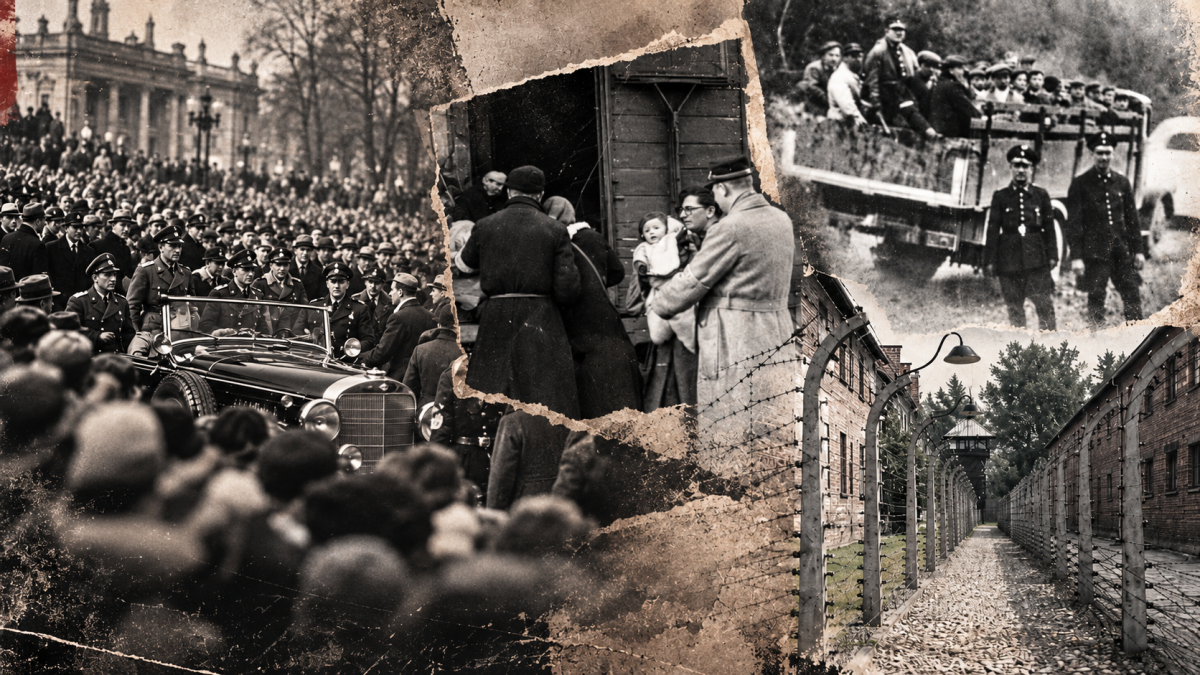
How It All Begins
Adolf Hitler himself had experienced the horrors of World War I. He served in the German army, saw combat, was wounded, and was awarded the Iron Cross. But for Germany, the war ended in catastrophe. After its defeat in 1918, the country lost territory, and the Treaty of Versailles in 1919 imposed enormous reparations. Millions of soldiers returned home, many physically and psychologically scarred. Then came political upheaval, the hyperinflation of 1923 that wiped out people's savings, and the Great Depression of 1929. By 1932, Germany had more than six million registered unemployed people. Many Germans felt humiliated, betrayed, and bitter. They desperately wanted their old lives back and someone to blame for their misfortunes.
Hitler understood these feelings remarkably well. During his speeches, he carefully watched the crowd's reactions: some words were met with silence, while others drew enthusiastic cheers. He remembered what resonated with his audience and developed those ideas further. In this way, a kind of feedback loop emerged between him and his listeners. Hitler promised to restore order, return Germany to its former greatness, and punish those responsible for its troubles. He declared Jews the nation's principal enemies, falsely blaming them for Germany's military defeat, economic crises, and the spread of communism. He did more than simply stir up hatred: he channeled the anger that had already accumulated in society toward targets of his choosing. On January 30, 1933, Hitler became Chancellor of Germany and soon established a dictatorship.
Interestingly, Hitler himself was unusually preoccupied with personal cleanliness and felt a strong revulsion toward anything he considered dirty or unhealthy. At the same time, he believed he bore a special responsibility for Germany's future and had to rescue the country from decline. Under Nazi rule, public hygiene campaigns were introduced, and in 1934 the "Beauty of Labor" (Schönheit der Arbeit) program was launched. It encouraged factory owners to clean up their workplaces, improve lighting, eliminate dirt, rats, and insects, maintain the surrounding grounds, and plant flowers. On their own, such measures seemed perfectly reasonable. But in Hitler's worldview, the idea of cleanliness was intertwined with a far more dangerous conviction: that German society itself supposedly needed to be purged of everything considered alien to it.
This was where the pursuit of order became intertwined with racial hatred. Hitler and Nazi propaganda portrayed Jews, Roma, and other persecuted groups as parasites, rats, and carriers of disease threatening the health of the German nation. This was the terrifying power of disgust: when people sense danger, they tend to flee, but when something fills them with revulsion, they often want to eliminate it entirely. The Nazis turned this logic into a state policy of "racial hygiene." At first, Jews faced restrictions on their rights; then the Nuremberg Laws of 1935 stripped them of full citizenship. In 1939, the Nazi program to murder people with disabilities and mental illnesses began, and from 1941 onward, the Nazis carried out systematic mass killings of Jews. At Auschwitz, they eventually even used Zyklon B, an insecticide originally developed to kill insects, for this purpose. Of course, genocide did not arise from public hygiene measures, but from racist ideology and deliberate decisions made by the regime. Yet the language of "purification" helped portray the mass murder of human beings as a necessary measure to protect the nation's health. Most horrifying of all, carrying out this policy did not require an entire army of committed sadists. Much of the criminal work was done by perfectly ordinary people. This is precisely what historian Christopher Browning explores in his book Ordinary Men.
How Ordinary Policemen Became Killers
Against this backdrop unfolds the story Christopher Browning investigated in Ordinary Men. In June 1942, Reserve Police Battalion 101 from Hamburg arrived in occupied Poland. The unit consisted of fewer than 500 men, mostly middle-aged workers, craftsmen, salesmen, and office clerks. Many were married and had children. Most had grown up before Hitler came to power and, unlike the generation raised in the Hitler Youth, had not undergone the Nazi system of youth indoctrination. Some were members of the Nazi Party, but the battalion was not made up of specially selected fanatics or professional soldiers. These men had been called up for police service and sent to occupied Polish territories.
Early on the morning of July 13, 1942, the battalion arrived in the Polish town of Józefów. The policemen had set out at around two in the morning, carrying extra ammunition. Most had no idea what assignment awaited them. Their 53-year-old commander, Major Wilhelm Trapp, whom his men called "Papa Trapp," addressed the assembled unit. He was pale, his voice trembled, and he could barely hold back his tears. The policemen were ordered to round up the local Jews, separate the able-bodied men for forced labor, and shoot everyone else—women, children, and the elderly. However, Trapp allowed anyone who felt unable to carry out the order to withdraw from the killings. Around a dozen men stepped forward. Among those who openly objected to the executions was Lieutenant Heinz Buchmann, who had worked in his family's timber business in Hamburg before the war. He refused to take part in murdering defenseless women and children. He was assigned other duties and later managed to secure a transfer back to Germany. The remaining policemen proceeded to carry out the order.
That day, approximately 1,500 Jews were murdered in Józefów. The victims were taken into the forest in groups, where the policemen shot them at close range. Among the participants was a policeman named August Zorn, who had been ordered to kill an elderly man who could barely walk without assistance. By the time they reached the execution site, the other victims were already dead. The old man collapsed to the ground and refused to go any farther. Zorn shot him in the back of the head but aimed too high. Horrified by the result of his shot, he felt sick and asked to be excused from further killings. Other policemen also found ways to avoid participating in the executions: some stayed near the trucks, delayed carrying out their assignments, or requested reassignment to guard duty. Their fellow officers called such men weaklings and cowards, but refusing to participate generally brought no serious punishment. After the massacre, the policemen returned to their barracks in Biłgoraj. Many barely ate and drank heavily. Trapp addressed his men, reminding them that the orders had come from the highest authorities. According to one participant's recollection, on the first night after the massacre, a policeman woke up and began firing his weapon into the barracks ceiling.
By August 17, 1942, units of the battalion were already participating in another mass shooting, this time of approximately 1,700 Jews in Łomazy. The operation was led by Lieutenant Hartwig Gnade. During the killings, he drank alcohol and tormented people awaiting execution. Initially, the shootings were carried out by auxiliary units brought in from the SS training camp at Trawniki. However, some of the men became so drunk that the German policemen had to take over and continue the killings themselves. More operations followed. On August 25–26, the battalion participated in the mass deportation of Jews from Międzyrzec Podlaski to the Treblinka extermination camp. Over the following months, the policemen conducted raids in ghettos, rounded up Jews, escorted them to trains, and sent them away in freight cars. In 1943, units of the battalion also participated in the so-called "Jew hunt"—searching for and murdering Jews who were hiding in forests, villages, and specially constructed shelters.
On November 3–4, 1943, the Nazis carried out Operation Erntefest ("Harvest Festival"), during which approximately 42,000 Jews were shot in camps across the Lublin district, including Majdanek and Poniatowa. Members of Reserve Police Battalion 101 also took part in the operation. By this point, the unit had been stationed in occupied Poland for approximately sixteen months. According to Christopher Browning's calculations, during this period the battalion's policemen had directly participated in the murder of at least 38,000 Jews and the deportation of approximately 45,000 more to Treblinka. In other words, a unit of fewer than 500 men had participated in killing or sending at least 83,000 Jews to their deaths.
The Most Terrifying Part Happens Gradually
One question inevitably arises after reading this story: were these policemen monsters from the beginning? There were certainly brutal fanatics and sadists among the Nazis, such as the physician Josef Mengele, who conducted inhumane experiments on prisoners at Auschwitz. But most of the policemen in Battalion 101 were not like him. They had families and jobs. They experienced fear, disgust, and guilt. And yet they participated in murder.
Why did the policemen continue killing even when they were allowed to refuse? One reason was their sense of comradeship. In a close-knit unit, refusing an assignment meant leaving all the unpleasant work to fellow officers. Some regarded this as cowardice and did not want to appear weak in front of the others. What would normally be considered a virtue—loyalty to one's comrades and a willingness to share their burdens—became a justification for committing a crime. The habitual tendency to obey authority also played a role, as demonstrated in the famous experiments of psychologist Stanley Milgram. Yet the case of Battalion 101 is particularly revealing because refusing to participate personally in the shootings generally did not result in serious punishment. The option not to shoot existed, but most men chose not to take it.
Equally important was the gradual desensitization to violence. After the first shootings, the policemen experienced intense psychological distress. Some felt nauseated, while others tried to numb their feelings with alcohol. But over time, they learned to cope with these emotions and continued carrying out their assignments. Their duties also varied: some personally shot people, while others guarded detainees or sent them to extermination camps. For the latter, it was easier to view their work as ordinary police procedure, even though the consequences remained the same. Each new criminal order seemed a little less unthinkable than the first. This was the gradual transformation Browning describes throughout his book: people for whom murder had once been unimaginable became accustomed to participating in it.
That is why, when reading stories like this, it is important not only to condemn the perpetrators but also to examine ourselves. When thinking about Auschwitz or the Soviet labor camps, it is far more comforting to imagine ourselves as people rescuing the innocent rather than guards carrying out criminal orders. But no one can guarantee in advance that, under similar circumstances, they would have been among the few who resisted. This is precisely what makes ideologies that offer simple answers to complex questions so dangerous. Nazism allowed Germans to feel morally superior, blame every problem on a particular group, and know in advance whom to regard as an enemy. Similar mechanisms of dehumanization and the division of society into insiders and enemies can be found in other repressive regimes, including those in the history of the Soviet Union and Cambodia. Ideology becomes both a club for the like-minded and a weapon against dissenters. The essential principle is this: once someone who disagrees with you is no longer seen as a person you can reason with, but instead as an enemy, it becomes easier to justify hostile actions against them.
But the most dangerous thing is that this transformation does not happen all at once. First, a person accepts the idea that a certain group of people is responsible for their problems. Then they begin to believe it is acceptable to restrict that group's rights, excuse unfair treatment, and turn a blind eye to violence. Each new step seems like only a slight extension of the previous one. It is much like someone gradually pushing past your boundaries. At first, they move forward just two millimeters. As soon as you begin to protest, they stop and wait for you to calm down. Then they advance another two millimeters. And they repeat this again and again, until one day you discover that you have been pushed almost five kilometers back from where you originally stood. Yet each time, you agreed to give up only a little ground. This is the central lesson of Ordinary Men: people rarely find themselves at the bottom of a moral abyss in a single leap. Far more often, they get there gradually, repeatedly accepting what they once believed was unacceptable.