A World to Return To: Why Young Readers Choose Maya Sara’s Books
At a book festival, you first pay attention to the books: new editions, striking covers, authors' names, queues at the stands. But sometimes the main event is not the book itself, but the people who gathered in one space for its sake. That was precisely the impression left by the meeting with Maya Sara at OQY BOOK Fest.
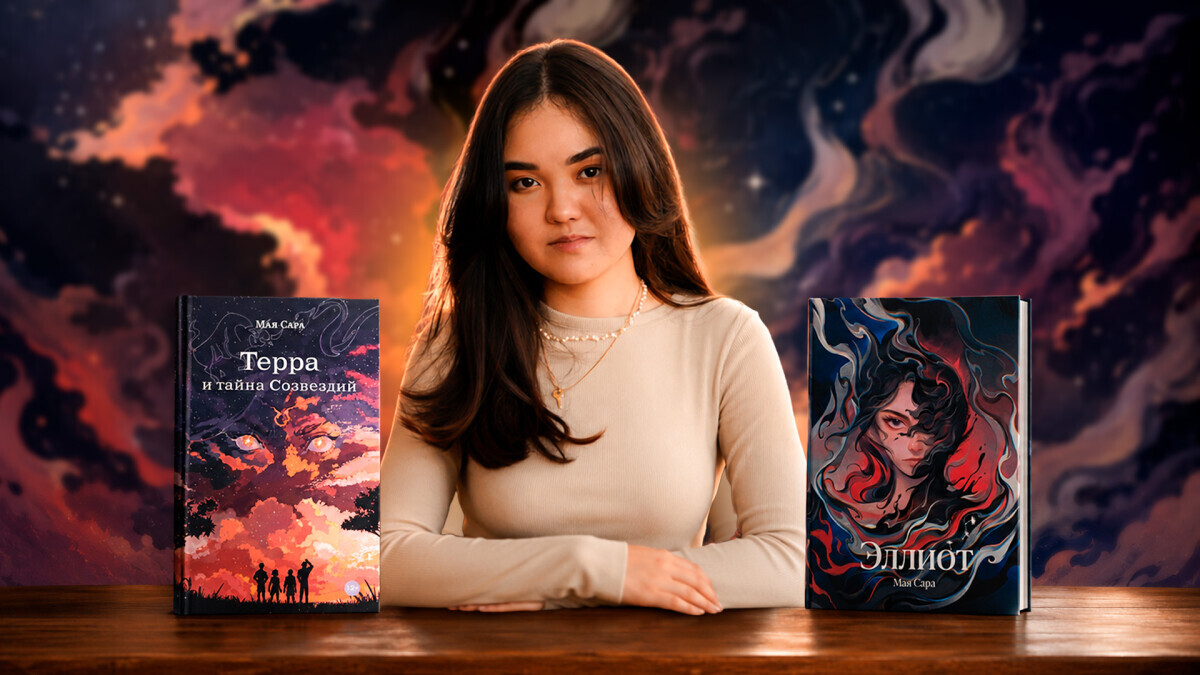
Maya Sara is a young writer, yet the audience that gathered to meet her was nothing like a casual public that had come simply to listen to another participant in the festival program. Sitting before the stage were readers who knew her books, remembered the names of minor characters, paid attention to illustrations and hidden details, awaited the continuation of plotlines, and built their own hypotheses about the future of the characters. Many came with books in their hands. Some were meeting the writer for the first time, while others had traveled from another city and unexpectedly received the opportunity to see the author of their favorite story.
Observing this audience, I tried to understand how such a young author managed to gather such an engaged reading community around her. It is likely not just about the popularity of the fantasy genre or the recognizable design of the books. Maya Sara’s readers feel a sense of involvement in the world she creates. They do not merely follow events; they experience them alongside the characters, notice character development, return to individual chapters, and wait for hidden details to be explained in the next installment.
Crucially, the majority of her audience consists of young readers. Today, it is often said that teenagers have stopped reading, that long texts have given way to short videos, and that books are no longer capable of holding the attention of the new generation. The meeting with Maya Sara proved the opposite. Young people did not just read her works – they analyzed them, compared books, asked about narrative structure, the internal logic of the fantasy world, character prototypes, and the author's creative crisis.
Perhaps the secret of this closeness lies in the writer's own tone. Maya Sara does not strive to appear before readers as someone to whom everything came easily. She speaks openly about publishing rejections, failed drafts, doubts, burnout, and the fear of remaining without an audience. Her heroines are also far from flawless: they make wrong decisions, hesitate, make mistakes, and at times annoy the reader. That is precisely why they are believed.
The conversation with Maya Sara best unfolded through questions from the hall. They revealed not only the audience's attitude toward the books, but also the topics that genuinely concern young readers.
– Your books Terra and Elliott are completely different in atmosphere. How did it happen that you began working on two such dissimilar stories simultaneously?
– I remember receiving rejections for Terra. No one wanted to take it. Then I decided to put the manuscript aside and start writing a new story. I thought that perhaps the new book would appeal to publishers and readers, and things would work out with it.
At that time, I had already begun working on Elliott. And right then, a publishing house came to me and said they wanted to release Terra. Work on the book began: editing, preparing the cover and illustrations. That is how it happened that I simultaneously began working on two completely different cycles.
Of course, in my ideal world, I would have first released the entire Terra cycle and only then moved on to Elliott, so that readers wouldn't have to wait too long for the continuation. But it turned out differently. I work on Terra, then move on to Elliott, and then return to Terra again.
The history of Maya Sara’s first book did not begin with instant success, but with rejections. This is an important detail, especially for young authors who often perceive a publisher's first negative response as a final verdict on a manuscript. In the case of Terra, rejection turned out not to be the end of the story, but a temporary pause. While one manuscript awaited its time, another artistic world emerged–Elliott.
"Heroines Must Make Mistakes"
– Your books center on strong heroines. How do you make such a character alive rather than simply the boldest, smartest, and most ideal?
– I really love strong main heroines. I grew up on fantasy books featuring incredibly strong girls who saved the whole world. But I always wanted readers to be able to find themselves in my heroines.
For that to happen, characters must not be ideal. They must make mistakes. Sometimes a reader should call a heroine foolish and ask: “Why is Terra making that decision?” Or feel angry at Elliott because she is making choices too slowly.
At the same time, I am very pleased when people say: “I liked Elliott” or “I liked Terra because she is brave.” I wanted readers to be inspired by them, for my heroines to help people find strength within themselves.
In adolescent literature, a strong heroine is sometimes understood too straightforwardly. She is attributed exceptional abilities, fearlessness, and a readiness to handle any problem. But such an image easily turns into a formula. Maya Sara chooses a different path: her heroines are strong not because they never doubt, but because they continue to act alongside their doubts.
The ability to feel annoyed at a character is also a sign of readerly intimacy. We rarely feel angry toward a character who is completely indifferent to us. The desire to argue with Terra or Elliott means the reader already perceives their decisions as the actions of a living person.
"I Wasn't Planning to Write a Sequel"
– The sequel to Terra is coming out soon. What should readers expect from the second book?
– First, I want to confess that I didn't plan to write a sequel at all. I thought the first Terra would come out, we would all collectively forget about it, and move on to Elliott. But it didn't turn out that way.
I realized that the second book had to be written. Readers were waiting for it, and I began waiting for the continuation of this story as well. The most important change is that the characters have grown up. Just like the readers, like all of you, and like me. Time has passed, they have grown older. Furthermore, for a time, they have separated.
The plot of the first book was a journey. The characters moved from one point to another, encountering monsters and new characters. In the second book, the main events will take place at a grand tournament. That is where the main battles, clashes, and meetings with villains will happen.
The sequel appeared not only thanks to the initial authorial plan, but also due to reader expectations. In this sense, the audience became a direct participant in the development of the cycle. Of course, the plot is written by the author, but the persistent question “When will the second part come out?” is capable of returning a writer to a world they were already intending to leave.
It is especially interesting that the early readers of the book grew up alongside the characters. Therefore, the sequel could not fully replicate the tone of the first part. Growing up here becomes not only a plot event, but a change in the very optics of the work.
"Now the Story Is Not Told by Terra Alone"
– You mentioned that the first and second books differ greatly. Have you changed yourself as an author?
– I cannot say I have changed very much, but the way I write has changed. Now I think more about my characters.
In the first book, Terra told the story herself. She reported where Gray was, what Theo was doing, where Felix was. The reader saw everything from her perspective.
In the second book, many new characters appear, so the story is told from the viewpoints of various characters. There will be chapters from the perspectives of Gray, Theo, and Felix, as well as several chapters from the viewpoints of new characters. But Terra still remains the main one.
For me, this was the first experience writing from the perspectives of other characters. I really enjoyed it. I think this is important for the second book, and I hope readers will like it too.
The shift in narrative perspective speaks of noticeable authorial development. Writing a single story through the voices of multiple characters is significantly harder than simply distributing chapters among them. Each of them must perceive space in their own way, notice different details, evaluate events differently, and possess their own speech intonation.
For a young author, transitioning from a single narrative center to polyphony becomes a serious test. Yet it is precisely this technique that can expand the artistic world and show that no single heroine, even a central one, holds the absolute truth about what is happening.
"What Can a Character Do to Surprise Me?"
– Does it ever happen that a character starts acting independently? You plan one action for them, and they seem to choose another?
– I more often ask myself the question: what can my character do right now that will surprise even me? Many unusual scenes emerge from that question.
I want the character to surprise not only the reader, but me as an author.
Maya Sara’s statement reveals an important principle of her work. A character must not become merely a tool necessary for advancing the plot. If their action is predictable in advance even to the author himself, the scene risks turning out predictable.
However, unexpectedness must not be accidental. A truly strong twist surprises, but afterwards the reader understands: this specific person is precisely the one who could have acted that way. Finding such a balance between unexpectedness and psychological truth is likely one of the most difficult aspects of writing.
"Leaving Was Scary"
– Were you scared to drop out of university and start writing a book? How did your parents react?
– When I was nineteen years old, I went to my mom and said: “I want to write a book. I’m dropping out of university. That's it.”
It was an important decision. University took up a lot of time that I wanted to dedicate to creativity. I didn't like where I was studying, I didn't like the environment I was in. I understood that it wasn't mine.
My mom supported me. She said: “Go ahead, move forward.” Time passed, I wrote Terra, we started working on it with the publishing house, edited the text, prepared the cover and illustrations.
Then I said I wanted to return to university. I enrolled in a different educational institution and chose a different path.
Yes, leaving was scary. But it seems to me that if you completely dislike what you are doing, if you realize it is not yours, you need to leave, change direction, and try something new.
Her mother occupies a special place in Maya Sara’s entire story. She was present at the meeting and several times became a silent but important participant in the conversation. It was to her that the young writer once came with the decision to leave university. It is to her that she turns today when she has doubts before a meeting or the release of a new book.
The support of loved ones does not guarantee instant success, but it gives one the right to try. Sometimes a person above all needs to hear that changing paths is not a defeat.
At the same time, the writer's story does not boil down to an opposition between education and creativity. Afterwards, she returned to studies, but made a more conscious choice. The main thing here is not the act of leaving university itself, but the ability to recognize that a decision once made can be reconsidered.
"What If No One Shows Up?"
– Do you still have the fear that readers won't accept the new book or won't come to the meeting?
– My mom can confirm this fear. I feel like I often come to her with such anxieties. Even before today's meeting, I walked up to her, lay down next to her, and said: “Mom, what if no one comes?”
Of course, I would be happy with any number of people. But I still feared that absolutely no one would show up.
This fear exists both before meetings and throughout the entire creative process. It is probably a normal part of a writer's life. But it is a normal fear.
I have learned one rule: if it's scary, you have to do it. You have to close your eyes and move forward.
At that moment, I particularly wanted to look back at the hall. Sitting before the writer were people who had come neither out of politeness nor by chance near the stage. They held her books, remembered plot details, and waited for the opportunity to ask a question.
A writer can almost never fully believe in the existence of their own reader. Even a successful book does not relieve the doubt before the next one. Every new story seems to start its path from a blank slate. Therefore, the fear of an empty hall is understandable even when the hall is already full.
"Don't Cry, Everything Will Work Out"
– What would you tell your past self if you could see yourself now?
– I would say: “Don't cry. Everything will work out. All readers will be found. Terra will be loved, Elliott will be loved. Everything will be fine.”
This was one of the shortest answers of the meeting, but perhaps one of the most sincere. Behind it stood publishing rejections, doubts about the first manuscript, the fear of making the wrong choice, and the anticipation of a reader who at that moment existed only in imagination.
Now that reader was sitting in the hall. And the words “all readers will be found” sounded no longer like consolation, but like an accomplished fact.
"Fantasy Is Truly Difficult to Write"
– I want to start writing myself, but I have too many ideas: modern romance novels, fantasy, and more complex stories. Is it difficult to create fantasy specifically? Many ideas have already been used, and an author has to invent a new world and its laws.
– It all depends on what kind of fantasy you write. There is fantasy based on the real world. Then you don't need to create everything completely from scratch: you take existing reality, add magic or unusual abilities to it, and working is a bit easier.
But there is fantasy in which the author creates their own universe entirely. That is difficult. You have to track every detail, not forget or lose anything.
Therefore, I might have decided to write a realistic book first to get a bit used to working with a large text. Fantasy is genuinely hard to write.
The young reader's question turned out to be one of the most substantial. It concerned not only inspiration, but also craftsmanship. Fantasy is often perceived as a genre of absolute freedom in which anything can be invented. However, the further a fictional universe is from reality, the greater the responsibility that falls on the author.
They must remember geography, history, character abilities, the mechanics of magic, and a multitude of minor rules. Even a miracle must possess a certain consistency, otherwise the reader stops believing in the world of the work.
"It's Fantasy–I Can Do Whatever I Want"
– Terra exists in a separate world. Has it ever happened that you wanted to add a character or a plot twist, but it didn't correspond to the physics of that universe?
– For me, it's more likely the other way around. Sometimes I want to do something, then I think: “That's illogical.” And then I remember: it's fantasy, I can do what I want and explain nothing to anyone.
In the writer's response, humor was audible, but at the same time it complemented the previous conversation about the complexity of the genre. An author must observe the internal logic of the created world, yet excessive control can restrict the imagination.
Sometimes it is useful for a writer to remind themselves that an artistic world is not obliged to literally replicate the laws of reality. Its persuasiveness depends not on similarity to reality, but on fidelity to its own logic.
"Right Now, the Second Terra Is in My Heart"
– Which book do you like more yourself: Terra or Elliott? Terra was your first experience, while Elliott was a new story and a new way to showcase characters.
– If we compare the first Terra and the first Elliott, I am closer to Elliott. I waited for a very long time for the moment when I could free myself and write that story.
But recently my close friend Nuray, who reads all my first drafts, read the second Terra and said she liked it more than Elliott.
I was surprised because I thought: “But Elliott is cooler.” Then I realized that the second Terra is special in a new way. Therefore, right now it is Terra 2 that is in my heart. When I start working actively on Elliott again, I will probably switch back.
Authors are not always able to choose a single favorite book. Often, the piece they are currently working on feels closest. It occupies their thoughts, demands decisions, and has not yet managed to detach itself from its creator.
The second Terra is especially important to Maya Sara also because it shows her evolution as a writer. This is no longer merely a return to a first success, but an attempt to re-enter a familiar world with different experience and more complex artistic tasks.
"Don't Forget Christina"
– Which moment from your books was the most emotional for you?
– Christina. Those who read Elliott will understand. Whoever remembers Christina–do not forget her.
It was an emotional moment, but I was ready for it.
Furthermore, something else related to my creative work is supposed to be announced today. During the work on this project, there were a lot of emotions. But for now, it's a secret.
The response provoked an immediate reaction from those who had read the book. The character's name proved sufficient for a shared understanding, requiring no explanation, to arise between the author and a portion of the audience.
Moments like these show how deeply a reader enters an artistic world. For everyone else, Christina remained just a name. For those who knew the story, it already contained an entire emotional episode.
"Readers Inspired Me to Write a Sequel"
– My daughter came to a book festival for the first time. We are from Ust-Kamenogorsk and accidentally ended up in the right place at the right time. She is your fan and would like to know what inspired you to write the second part of Terra and when the continuation of Elliott will be released.
– I was inspired to write the second Terra by readers who asked every day when it would come out. That was my biggest inspiration. I wanted to write a book that they would definitely like. At least, I really hope so.
The second Elliott is currently being written very carefully and meticulously. It is not an easy book because a lot of events take place in it. Those who remember the finale of the first part know that it is quite complex.
I want to work thoroughly on the sequel so that everything turns out well. I don't want to rush. It is important that the book is high-quality, beautiful, and pleases the readers.
Waiting for a sequel always pits two different senses of time against each other. To the reader, it seems the book is being created for too long. For the author, however, months of work may prove insufficient, especially if many plotlines need to be tied together and audience expectations met.
Maya Sara did not state an exact date, preferring to speak about the quality of the text. For a writer who already has a dedicated audience, this is also a form of responsibility: not merely to continue the story, but to ensure the new part is not a hasty response to the popularity of the first.
"Asteris Is Inspired by My Friend"
– When you wrote the first Terra, were any characters similar to you or your loved ones?
– I have a friend whom you may have seen in my social media. We read the first Terra together, and she shared her impressions in my Telegram channel. She has very red hair and is very beautiful. She became a major inspiration for the image of Asteris.
That is perhaps the only such direct example. Characters are usually born from emotions. I think about what kind of character I want to feel and create, and they gradually appear.
I am inspired by music, films, and TV series, as well as the emotions I experience when watching and listening to all of that.
A real-life prototype in literature is rarely transferred into text without changes. More often, a person gifts the author a distinct physical trait, a gesture, a mood, or an emotional impression. Next, the character begins to live by the laws of the work.
In Maya Sara’s case, it is especially noticeable that the foundation of a character is not biographical similarity, but a feeling. First, the author determines the emotional content of the image, and only then finds a character, appearance, and place in the plot for them.
"At First, I Wrote Anime Fanfiction"
– How did you realize you wanted to become a writer? What has writing changed in your life?
– I started writing stories at around fourteen or fifteen years old. That was anime fanfiction which I posted online.
For me, they were like a personal diary. I would publish a new chapter and then talk about something from life: who I liked at school, who my crush was. People wrote: “Maya, you write coolly.” That was when I realized I was good at it.
I always wanted to share my imagination. At first, I thought I would do it through videos, films, or cartoons. Then I grew to love writing.
I am very happy and feel that I am doing the right thing.
A modern young writer's path often begins not with a literary journal or a manuscript sent to a publishing house, but with an internet platform. Fanfiction gives a teenager an important opportunity: to write without fear of official evaluation and to receive feedback almost immediately.
In this sense, Maya Sara’s early online readers played a noticeable role. Their simple phrase “You write coolly” helped her see a possible vocation in her hobby for the first time.
That Is How Elliott Appeared
– Did it ever happen that a single scene appeared in your head, and then the whole plot grew around it?
– That is precisely how Elliott appeared.
During the lockdown, only one McDonald’s was open. My mom and I went there. You couldn't sit inside back then.
There I saw a little girl and her dad. That is how Elliott and her father appeared.
Sometimes completely random thoughts come to your head, and then an entire story is born from them.
In a writer's imagination, a random observation can linger longer than an important event. Perhaps the girl and her father didn't even notice the person looking at them from the side. For them, it was an ordinary day. For Maya Sara, the short scene became the beginning of a fictional universe.
The most interesting thing in such stories is the impossibility of determining in advance which particular image will prove significant. An author does not always sit down at the desk with a finished idea for a novel. Sometimes an expression of a face, a gesture, or the interaction between two strangers appears first, and everything else arises significantly later.
"Some Details Appeared Accidentally"
– Are there hidden details or Easter eggs in your books that readers don't notice the first time? Do you plan them out in advance?
– In Terra, some details appeared on their own. I often tell readers to pay attention to a specific chapter and illustration in the first book. At first, everything arose almost accidentally, but then it began to heavily influence the plot of the second part.
In Elliott, every symbol, every hidden meaning, and every plot detail was planted purposely.
If you don't understand something now, you will understand in the second or third book. Then you'll return to the beginning and see why that detail was needed. I am really looking forward to that moment.
This answer was especially liked by the audience. Young readers love not only following the direct progression of the plot, but also decoding the text. An illustration, a short line of dialogue, or a symbol can turn into a promise of a future discovery.
It is also interesting that the writer herself distinguishes between accidental and pre-planned details. A literary text is not always born according to a fully prepared scheme. Sometimes an element that arose almost intuitively later acquires meaning and begins to determine the development of the entire story.
"He Will Put Terra in a Difficult Position"
– We were shown a new character, but his name wasn't given. Will he heavily influence the events of the second Terra?
– I almost said his name just now. It's already constantly ringing in my head.
You will find out his name as soon as you open the second Terra. At the beginning, there will be character portraits, and his name will appear there.
He is not the most active participant in the story, but he will do something because of which Terra will end up in a very difficult position. He is connected to the villainous side of the plot.
Maya Sara carefully avoided direct spoilers, but even such hints were enough for readers to start building hypotheses. For the audience of serial literature, awaiting a new book becomes an independent part of reading.
The story exists not only on already published pages. It continues in theories, discussions, illustrations of new characters, and accidental slips of the tongue by the author.
"I Think It's Called Burnout"
– How long do you work on each book, and how much time do you dedicate to writing?
– Usually, one book takes about a year. Sometimes a little less, sometimes more. That applies to work on the main text.
After that, a whole team works on the book: editors, illustrators, and other specialists.
When I am actively writing, I start around eight or nine in the morning and continue until late evening. I work like that every day except weekends.
– And what do you do when you run out of emotions to continue?
– I rest. I think it's called burnout or writer's block.
During such periods, I listen to music I love, rewatch films and series that once inspired me. Sometimes emotions return after that, but most of the time a long rest is required.
Behind bright covers and festival meetings, it is easy to miss the everyday side of writing. Between an idea and a finished book lies a year of regular work, after which the text still undergoes editing, artistic design, and preparation for publication.
The intense schedule explains why the conversation about burnout turned out to be so important for the author. Creativity does not cancel physical and emotional fatigue. Moreover, the constant demand to be inspired can turn a favorite pursuit into a heavy chore.
"During a Crisis, You Mustn't Force Yourself to Write"
– How do you cope with a creative crisis? Where do you draw inspiration to continue writing?
– Everyone has crises. I rest a lot.
For me, a crisis means that I must not write right now and must not force myself. I lie down, rest, try not to look at my phone, read books, and watch TV series. I just do everything an ordinary person does.
In the modern conception of success, rest is often perceived almost as a weakness. A young author is advised to be disciplined, write every day, and not wait for inspiration. Maya Sara does not deny discipline–her own working schedule is quite strict. But she distinguishes between ordinary unwillingness to get to work and genuine exhaustion.
Her advice not to fight a crisis at any cost sounds especially convincing precisely because it comes from a person capable of working on text from morning until late evening. Rest here is not opposed to labor. It becomes the condition without which continuing work is impossible.
"Sometimes I Think the Book Is Terrible"
– Have you ever wanted to stop writing altogether?
– Yes, that happens. When I am working on a draft, I dislike everything. I think: “What a foolish book. What a terrible book I'm turning out.” It’s about like that every time.
At such moments, I ask myself: why did I even start doing this? Why did I like writing so much the first time?
When I remember that love, I tell myself: “Alright, let's keep going. The book isn't foolish. Everything will be fine.”
A finished book creates the illusion of wholeness. The reader sees a structured plot, formatted text, and finished illustrations. They do not see the stage at which the author doubts almost every decision.
Maya Sara’s response returns processuality to the book. Before publication, a work more than once seems unsuccessful to its author. Perhaps the ability to continue working consists not in constant confidence, but in the readiness to survive the period when that confidence is absent.
"A Book in a Different Genre Will Come Out Soon"
– You have already written several fantasy books. Do you plan to work in other genres?
– Yes. Two events are happening simultaneously today. I am physically here, and an event will soon take place in another city where my new book will be announced.
It will come out very soon and will be in a slightly different genre. Readers will find out everything in the near future.
A successful cycle can easily turn into a limitation for a writer. The audience expects a familiar world, the publisher understands what is currently in demand, and it is easier for the author to continue down a once-found path.
Therefore, the announcement of a new book in a different genre is important not only as news. It demonstrates Maya Sara’s aspiration not to turn her own success into a repeating formula.
A Meeting That Continued Beyond the Stage
At the end of the conversation, the organizers suggested choosing the best question. Doing this was not easy. Readers asked not only about favorite characters and sequels, but also about the internal structure of the work, authorial choices, and the psychological side of creativity.
The question about the difficulties of creating a fantasy world was especially memorable. Its author received a gift. However, the meeting itself showed that the most valuable thing for the writer was the presence of people who came with her books.
When participants were asked to hold up the copies they had brought, a multitude of Terras and Elliotts appeared in the hall. It was a simple yet very expressive gesture. Before the meeting, Maya Sara had feared no one would come. Now, readers capable of remembering even the details the author once hid in illustrations sat before her.
After the conversation, the autograph session began. Communication continued without microphones: in short personal chats, photographs, book signatures, and questions that didn't manage to be voiced from the stage.
Maya Sara’s phenomenon lies, likely, not only in the fact that a young author managed to gather a large audience. What matters is what kind of audience that was. Sitting before the writer were not passive fans of a famous name, but attentive readers ready to discuss character development, the laws of the fantasy world, narrative voices, and hidden symbols.
The young writer found a path to the young reader without simplifying the conversation with them. She allowed her audience to argue with characters, look for clues, wait for sequels, and see a living human behind the finished book–a human who doubts, tires, fears an empty hall, but still continues to write.
To the question of what rule helps her move forward, Maya Sara replied:
– If it's scary, you need to close your eyes and move forward.
Perhaps that is precisely why her characters and readers understand each other so well. They grow not when they stop being afraid, but when they resolve to continue their journey.