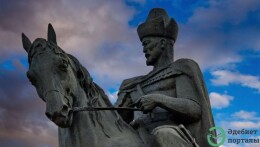
ABAI’S TEACHING AS SPIRITUAL IMMUNITY
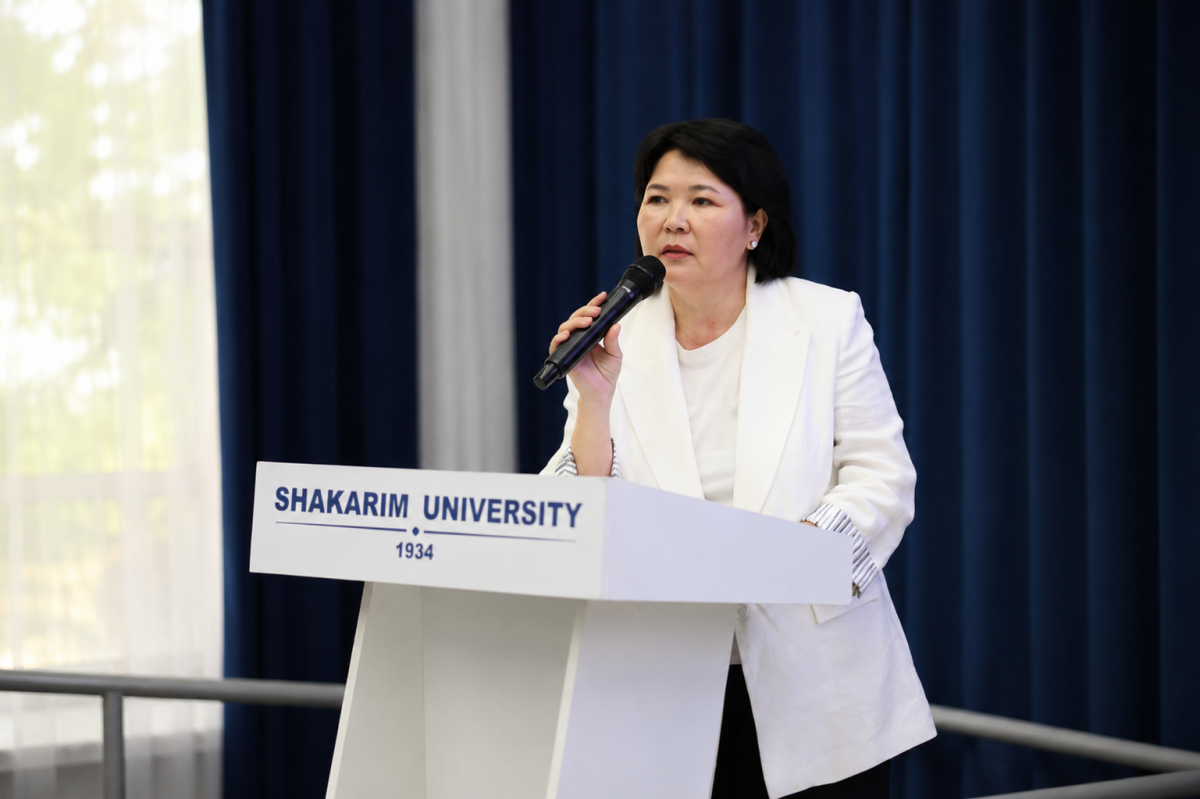
On August 10, 2026, the online seminar “Abai’s Legacy: Scientific Understanding and Contemporary Society” was held at L.N. Gumilyov Eurasian National University. The event brought together scholars and researchers from universities and academic institutions across Kazakhstan.
The discussion focused on contemporary approaches to Abai studies, his literary and philosophical legacy, the relevance of the concept of the “Complete Person,” new directions in Abai scholarship, and the teaching of his works in modern education.
Among the speakers was A. Smagulova, Candidate of Philological Sciences, Shakarim University, who addressed the place of Abai studies in the twenty-first century and the continuing relevance of his ideas in a rapidly changing society.
ABAI’S TEACHING AS SPIRITUAL IMMUNITY
Abai’s legacy is the foundation of Kazakhstan’s national spiritual code. He was not merely a poet, but a thinker who helped define the moral orientation of society. The values he championed, such as the pursuit of knowledge, diligence, honesty and justice, remain among the key foundations of social development today.
The twenty-first century is an age of rapid technological progress, when artificial intelligence is beginning to enter almost every sphere of human life. In this era, the way people think, communicate, perceive the world and understand values is undergoing profound change. At such a complex and uncertain time, Abai Kunanbaiuly’s spiritual legacy is not simply a monument to the past for the Kazakh people. It is a school of thought that can offer guidance for the present.
The twenty-first century, artificial intelligence and digital civilization all represent the external development of humanity. Yet when it comes to inner development, the ideas expressed by Abai have lost none of their relevance.
Abai should be regarded not only as a classic included in the curriculum, but also as a teacher for life. His concept of the “Complete Person” can help young people develop a culture of self-improvement, responsibility and critical thinking.
To engage with Abai’s teaching does not mean simply praising Abai. It means being able to connect his ideas with contemporary society and the new technological age. We need to understand that reading Abai is not merely about learning history, but about learning to understand ourselves. This is why it is important to present the great thinker in modern formats, through digital platforms, podcasts, videos and AR/VR projects. Interactive lessons and creative content on social media can also help increase young people’s interest in his legacy.
Artificial intelligence processes information, writes texts, creates images and solves problems. But it does not bear responsibility, nor does it make spiritual or moral choices. The age of artificial intelligence has made Abai’s concept of the “Complete Person” more relevant than ever. The more technology develops, the more pressing the question becomes of how a human being can remain truly human.
Technology may make human life easier, but it cannot create humanity or moral character. That is why the issues of conscience, justice and responsibility raised by Abai play an important role in balancing technological progress with spiritual values.
Abai criticized such negative tendencies in society as laziness, indifference, ignorance and careerism. These problems have not lost their relevance today. His ideas encourage society to examine itself critically.
Abai regarded ignorance, laziness, vanity and self-interest as some of the most serious illnesses of society. These traits still exist in the twenty-first century and, in all likelihood, will continue to exist as long as humanity itself does. What matters is whether a person is capable of recognizing and struggling against these weaknesses within themselves. Therefore, Abai’s criticism is not merely historical. It is a criticism of human nature.
In today’s language, Abai’s Words of Edification can be understood as an ethical code and a form of spiritual navigation. In his nineteenth Word, the thinker states: “One human being surpasses another through intellect, knowledge, conscience and character.” This idea resonates strongly with the modern principles of meritocracy, a society in which achievement is based on ability and effort.
Abai should be read not only during anniversaries and commemorative occasions, but in everyday life. His words are a spiritual compass, and his legacy is one of the pillars of the nation. A society that knows Abai will not easily become spiritually weakened, and a nation that understands Abai will not lose itself.
Abai asks us not merely to criticize society, but to correct ourselves; not to search for someone else to blame, but to cultivate our own character. Therefore, there is only one answer to the question of “Abai and us”: it is not Abai who has yet to reach us, it is we who have yet to reach Abai.