Akhmet Barzhaksyuly is the figure who published a book of Kazakh proverbs
Every thinking person of a mature generation should be concerned not with the latest Western trends on social media, but with the figures of Kazakh history whose names are fading from memory. In this article, we discuss Akhmet Barzhaksyuly – a remarkable figure who served his country well, even though his name is not frequently cited in literary circles. While some may recognize the name of public figure Akhmet Barzhaksyuly, others certainly do not. He made significant contributions to our national literature for the public good. He was one of those noble individuals who, in the early 20th century, undertook the systematic task of collecting proverbs and sayings from the people and publishing them in book form.
Kazakh oral folklore is the unwritten history of the people – an artistic chronicle never committed to paper. Every epic poem, legend, proverb, and saying, passed down orally through the centuries, deeply preserves not only the nation's way of life but also its worldview and spiritual essence. Ultimately, a single eloquent phrase can encapsulate the people's life experience, traditions, customs, and understanding of humanity. Perhaps this can be considered a unique manifestation of national wisdom. We ought to know how the proverbs and sayings we use today have survived to the present, and who the individuals were that made such significant contributions to collecting, recording, and preserving this priceless national heritage for future generations.
Such individuals must not be forgotten. Who was the first to introduce Kazakh proverbs to the general public through print? It was Akhmet Barzhaksyuly. Every thinking person of a mature generation should be concerned not with the latest Western trends on social media, but with the legacies of such Kazakh figures whose names are fading from memory. In today’s article, we discuss Akhmet Barzhaksyuly – a remarkable figure who made significant contributions to the nation, even though his name is not frequently mentioned in literary circles.
While some may be familiar with the name of public figure Akhmet Barzhaksyuly, others certainly are not. He made significant contributions to our national literature in the service of the public good. He was one of those distinguished individuals who, in the early 20th century, undertook the systematic task of collecting proverbs and sayings from the people and publishing them in book form.
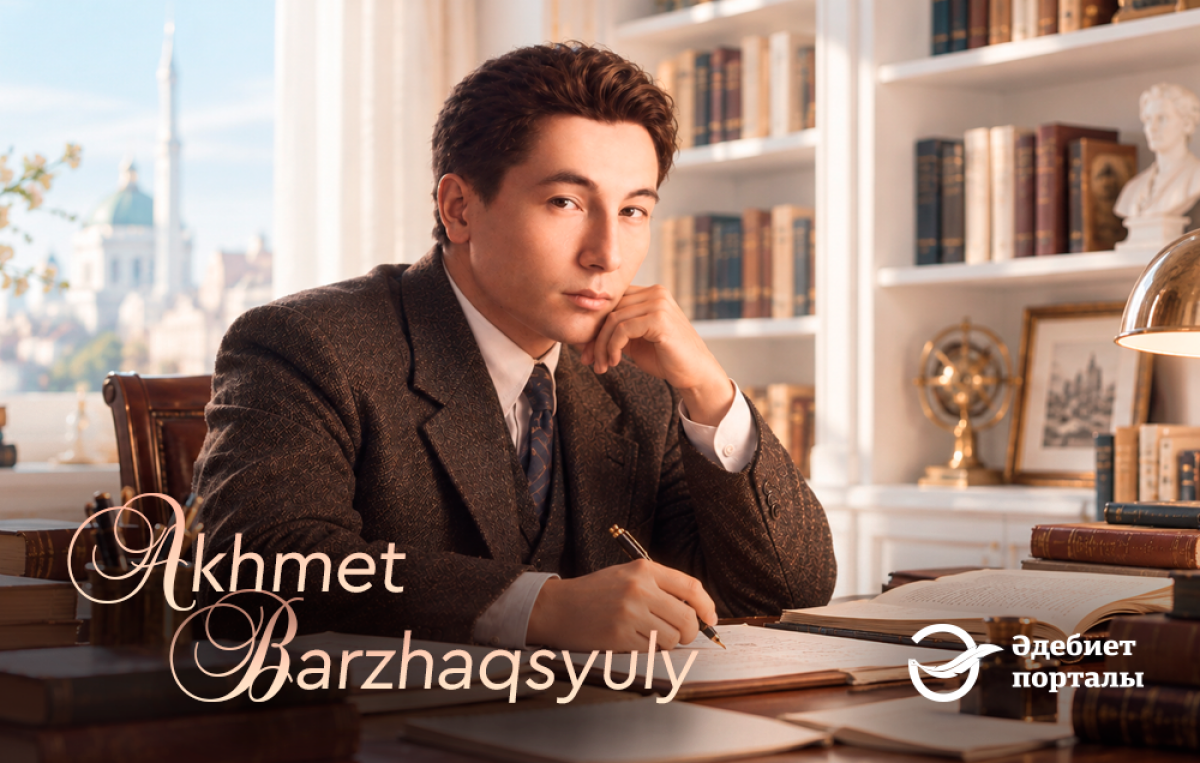
Is it possible to encapsulate the wisdom a people has amassed over centuries within a single book? It is indeed possible, provided there is someone who can internalize the people's words, grasp their meaning, and sense the pulse of an entire era through their proverbs. The life of Akhmet Barzhaksyuly – who collected thousands of Kazakh proverbs and sayings in his time and entrusted them to posterity – stands as proof of this.
This public figure was born on September 14, 1894, in the Zhezdi *volost* (district) of the Atbasar *uyezd* (county) in the Akmola region. He was a folklorist, translator, and literary scholar who studied Kazakh oral literature. Akhmet’s father, Barzhaksy, was one of the wealthy individuals in the Zhezdi district during his time; literate in Persian and Arabic, he also possessed a basic knowledge of Russian. A wise father, he encouraged Akhmet and his three other sons to pursue education. Of Akhmet’s three older brothers – Birimzhan, Torezhan, and Elemes – one trained as an agronomist, another as a veterinarian, and the third as a medical assistant.
Following in his older brothers' footsteps, the young Akhmet enrolled in the Russian-Kazakh school in Atbasar. After completing his studies there, he attended the Omsk Teachers' Seminary and chose a career in education. Subsequently, he furthered his education at an agricultural college in Omsk. Later, he honed his professional skills by studying at the Literary Institute in Moscow. Energetic and proactive from a young age, Akhmet also actively participated in the country's social, cultural, and educational activities; indeed, Akhmet Barzhaksyuly was among those who helped found the "Birlik" organization in Omsk.
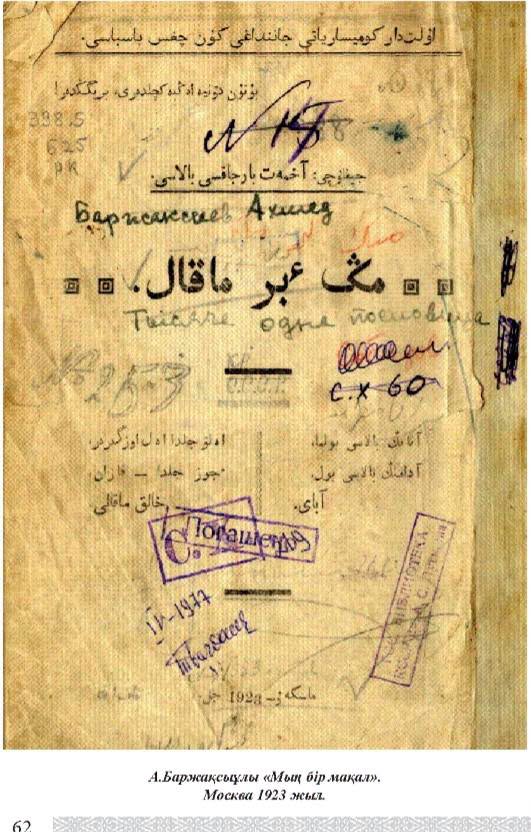
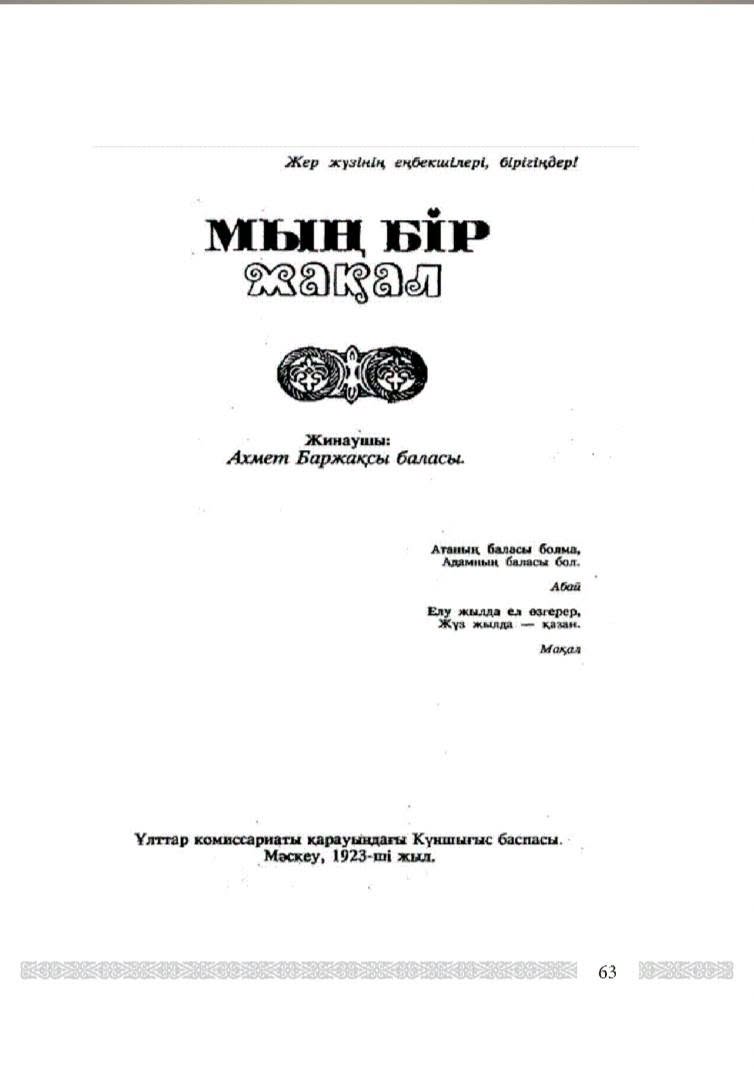
Kazakh oral folklore represents a vast world of centuries-old wisdom, and within that realm, the name of Akhmet Barzhaksyuly holds a special place. His significant contribution to Kazakh culture is the collection of proverbs and sayings titled "Myn Bir Makal" (A Thousand and One Proverbs). Between 1913 and 1914, he traveled among the people, gathering proverbs and sayings directly from oral tradition and amassing a total of 1,710 entries. The collection was subsequently published in 1915, featuring the text in both Kazakh and Russian. This marked one of the first and most important steps toward systematically collecting the nation's folklore heritage and making it available to the public through publication.
However, it is evident that the value of Barzhaksyuly’s work is not measured merely by the number of proverbs he collected. He did not simply record and list the sayings of the people; he delved into the inner voice and nature of the ideas embedded in these proverbs and sought to define their role in the life of the nation. Akhmet Barzhaksyuly categorized folklore into genres such as fairy tales, poems, riddles, and proverbs, providing a distinct characterization for each. In his view, oral folk literature serves as a crucial key to understanding the people's way of life and their worldview, as he emphasizes that proverbs encapsulate not only profound meaning but also the centuries-old experience, history, and wisdom of the nation.
At first glance, a proverb appears to be merely a brief phrase. Yet, beneath those few words lie profound meaning, a wealth of life experience, and the history of an entire steppe people. Refined over centuries, every proverb serves as a mirror reflecting the nation's worldview and mindset—a spiritual chronicle preserved in the collective memory of the people. A single folk adage, such as "When the many unite, they become a nation," reveals an entire worldview; when hundreds or thousands of such proverbs are gathered together, they form a clear picture of the people's way of thinking.
He fate of "A Thousand and One Proverbs" was arguably as complex as the life of its author. As previously mentioned, the work – which first appeared in 1915 – was republished in 1923 by the "Kunshyghys" (Orient) publishing house in Moscow, featuring a foreword by Nazir Torekululy. Meanwhile, the life of Akhmet Barzhaksyuly is inextricably linked to the tragic history of the Kazakh intelligentsia in the early 20th century. A man who endured a difficult destiny and a short life, he voluntarily withdrew from the Bolshevik Party in 1928. In 1929, this public figure was arrested on false charges of "undermining the party's prestige" and being a "Trotskyist," and was subsequently exiled to Western Siberia.
Although he returned to his homeland in 1933, a decree issued on March 15, 1934, sentenced him to another five years of imprisonment, and in 1935, his life was cut short when he was condemned to execution by firing squad. Following this, the fate of the book he left behind also changed drastically. In 1937, *One Thousand and One Proverbs* was classified as "harmful to the public," and the work was banned from circulation. The fact that a book compiling the wisdom of the people accumulated over centuries was suddenly deemed "harmful" serves as a stark illustration of the severity of the ideological pressure exerted during that era.
It is evident that Akhmet Barzhaksyuly’s creative legacy in native literature was not limited solely to the collection of proverbs and sayings. Furthermore, his articles and stories addressing issues such as education, women's equality, and national culture were published in newspapers of the era—such as *Qazaq*, *Alash*, *Saryarqa*, and *Ush Zhuz* – as well as in the magazine *Aikap*. Additionally, being proficient in Russian, the writer translated several works by the classic author Leo Tolstoy into his native language and published them in *Aikap*.
In addition, Barzhaksyuly was actively involved in public life. He served within the Soviet administrative structures of the Akmola region. Later, he became the chairman of the Kazakh Union of Consumers and worked in the National Bureau. At one point, he also successfully served as the representative of the Central Union of Consumer Societies in Berlin.
Thus, the life of this noble figure – who gathered the finest gems of language, strove for knowledge, and dedicated himself to literature and culture – was cut short before he reached the age of forty. Yet, he left behind a valuable legacy of work for his nation. He extended the life he was denied through his contributions to the country and the words he bequeathed to his people. Though his life was brief, the spiritual heritage he amassed endures alongside the people.
The photographs were obtained from open sources