Latif Hamidi and the Birth of a New Musical Tradition
The name of Latif Hamidi has been familiar to me since school years. Back then, it was associated primarily with the State Anthem of Kazakhstan and seemed like one of those names that simply had to be memorized. Over time came the realization that behind this name lies an entire era of Kazakh musical culture.
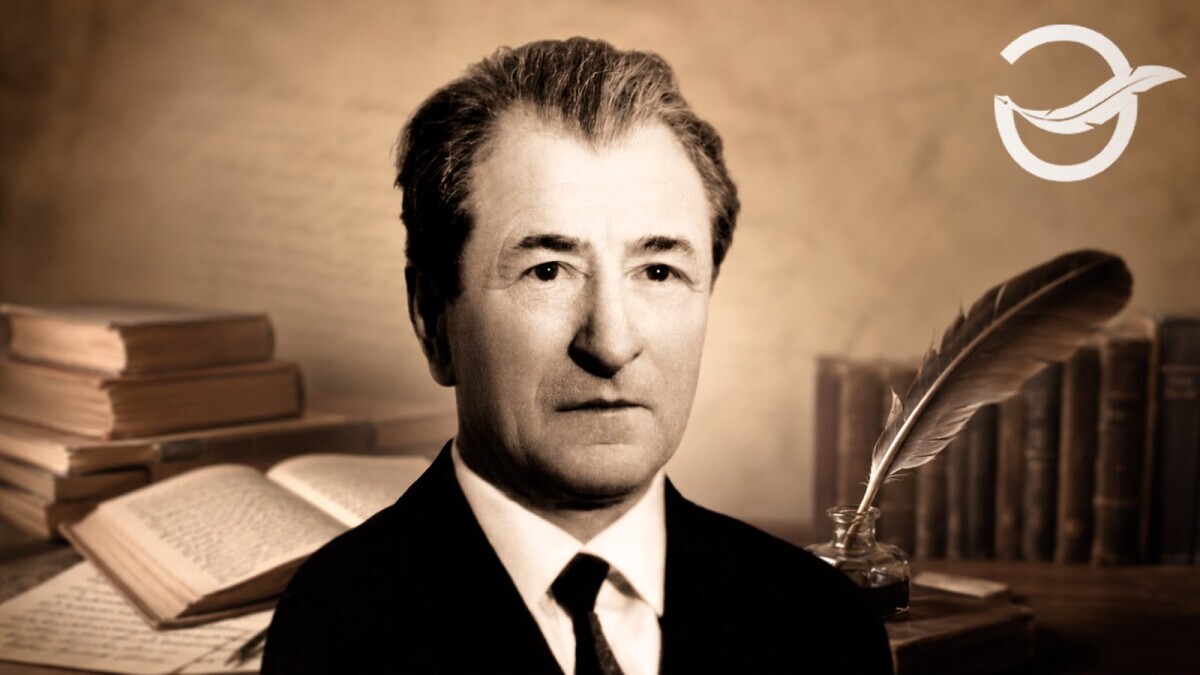
It is enough to hear the opening bars of the Kazakh Waltz for a strange, almost domestic familiarity to arise. This melody could play on the radio, in a concert hall, at a family celebration, or be performed by a singer whose name we no longer remember. It has long since detached itself from the time of its creation and become part of our shared auditory experience. This is one of the distinct features of Hamidi’s creative destiny: his works are frequently recognized long before anyone remembers the author's name.
The year 2026 marks the 120th anniversary of the composer’s birth. This jubilee provides an occasion to revisit his biography, yet Hamidi’s significance is by no means exhausted by a commemorative date. He was not only the author of popular songs and large-scale stage works; he recorded folk melodies, directed choirs and orchestras, worked in theater and radio, taught, and participated in the creation of educational manuals. In other words, he wrote music while simultaneously shaping the environment in which it could be heard, performed, and passed down to future generations.
From Mandolin to the Professional Stage
Latif Hamidi’s future path toward Kazakhstan-wide renown began far from Kazakhstan. He was born on July 17, 1906, in the village of Buvali in the Kazan Governorate, into a modest Tatar family. His childhood was not filled with home concerts, private lessons, or the cultural environment familiar to many musicians. The family moved frequently, adults had to search for work, and the road to the profession unfolded gradually through school and the people who managed to notice the boy's abilities in time.
Hamidi’s first musical mentor was Gimat Temirbulatov, who taught him to play the mandolin, later followed by the violin and piano. However, the young musician was interested in more than just instruments. He paid close attention to literature, tried his hand at writing, and was fascinated by poetry and the very sound of human speech.
For a future creator of songs, romances, and operas, this proved to be a rigorous school. In Hamidi’s mature works, the melody typically does not overpower the poetic text nor exist separately from it. It seems to continue the intonation of the word, helping it acquire a voice and emotional depth.
In 1920, the family moved to Tashkent. This city became Hamidi’s first major cultural school, where different languages and musical traditions sounded side by side, and Kazakh songs and kyuis existed not as material from an archive collection, but as part of daily living.
Next came studies at the Institute of Education, professional training in Moscow, classes at the First Musical Technicum, and the Tatar Opera Studio at the Moscow Conservatory. Hamidi worked in theater, wrote songs to poems by Musa Jalil, and mastered choral and orchestral practice. Consequently, when he arrived in Kazakhstan, he was no longer merely a gifted individual with a good ear; he possessed knowledge, theatrical experience, and an understanding of how a national melody could enter a new musical form.
Alma-Ata, Where Everything Was Just Beginning
In 1933, Hamidi arrived in Alma-Ata and began working at the Kazakh State Drama Theater. He conducted, wrote music for theatrical productions, and directed the musical department. What matters in his biography is not just the title of his position, but the timing of his arrival.
The professional musical life of the republic was then only taking on distinct outlines. Theaters and orchestras were being established, repertoires were forming, educational institutions were opening, and the first major works in new genres were appearing.
The Kazakh vocal and instrumental tradition already possessed immense artistic power, but it had yet to master the spaces of opera, choir, radio, and the large concert stage. Hamidi did not arrive in Kazakhstan when the system was already complete and it remained only to find one's place within it; he joined the work at its formative stage.
Working nearby were Akhmet Zhubanov, Yevgeny Brusilovsky, Boris Yerzakovich, Alexander Zatayevich, Zhumat Shanin, Mukhtar Auezov, and other figures without whom this period cannot be imagined. Hamidi was distinguished by the breadth of his interests and a rare practicality. He could work with a theatrical score, record a folk song, rehearse with a choir, handle orchestration, or explain the foundations of musical form to students.
Throughout the 1930s and 1940s, his activities spanned the theater, radio, capella, folk orchestra, music college, and conservatory. Therefore, his place in history is defined not by a single successful piece, but by his participation in building the very fabric of professional music.
Recording a Song Without Stripping It of Its Voice
One of the principal aspects of Hamidi’s work was the collection and arrangement of folklore. He recorded over two hundred folk songs and instrumental pieces, and prepared more than a hundred arrangements of Kazakh, Tatar, Bashkir, Uzbek, and Turkmen melodies.
At first glance, this might seem like the work of an archivist who merely preserves what others have created. In reality, the success of future generations hearing a song accurately depended entirely on the ear and precision of the person recording it.
Oral melodies do not recognize a single, permanently fixed version. Each performer alters the breathing, the duration of a sound, the rhythmic pattern, and sometimes even the direction of a phrase. Transferring such music onto staff paper is no easy task; preparing it for a choir or orchestra while ensuring that polyphony does not swallow the freedom and character of the original source is even harder.
Hamidi sensed this boundary acutely. He did not force a folk song into a rigid academic template, but instead sought a new form for it while preserving its recognizable intonation.
Particularly significant was his work with Abai’s songs. In Semipalatinsk, Hamidi recorded them from a relative of the poet who preserved the family’s performance tradition. Later, these materials entered collections and were utilized in the creation of the opera Abai. Thus, a song that had long been passed from one voice to another received musical notation, theatrical development, and a new life within a large-scale work.
Hamidi understood the entire journey of a melody, from live performance to the final score. In 1940, he headed the Kazakh State Capella; in 1943, he directed the folk orchestra of the Radio Committee; and in 1944, he took charge of the Department of Folk Instruments at the Alma-Ata State Conservatory.
He could hear a song, record it, arrange it for a new ensemble of performers, and then teach young musicians how to handle it with care and professional rigor.
A Waltz That Became Its Own
Even if Latif Hamidi had written only the Kazakh Waltz, that single piece would have been enough to preserve his name in the history of national music. However, the label "first Kazakh waltz" explains far from everything. It is far more interesting to understand why a European dance genre was so naturally embraced by Kazakh listeners.
The Kazakh Waltz appeared in 1940 as music for Gabit Musrepov's radio play Two Holidays. Later, the melody broke away from its original plot and embarked on an independent concert life.
Hamidi did not simply add a few national turns to a European rhythm; he altered the internal sensation of the genre. The triple-time movement subordinated itself to a flowing vocal phrase, and the waltz shed its salon coldness to acquire the soft lyricism of a Kazakh song.
The piece gained special renown through the performance of Kulyash Baiseitova. Her voice helped the melody transcend the boundaries of the radio broadcast and brought it closer to a wide audience. Listeners began to perceive the waltz not as an experiment in merging two traditions, but as a fully realized song that seemed to have always existed within the cultural memory.
A refined sense of the vocal line is likewise noticeable in the song Bulbul (The Nightingale). At the center of the piece is not an external effect, but the voice itself, its breathing, and its capacity to sustain a long emotional phrase. Hamidi wrote over fifty songs and romances, and even within his instrumental music, one frequently hears a desire to make the melody "sing." This is likely why his compositions are easily memorized while never feeling oversimplified.
Abai: The Union of Two Musical Characters
The pinnacle of collaboration between Latif Hamidi and Akhmet Zhubanov was the opera Abai, set to a libretto by Mukhtar Auezov. Its premiere took place on December 24, 1944.
The authors faced a challenging task: to create not a mere illustration of the poet’s biography, but a fully-fledged musical world in which Abai’s persona, the conflicts of the era, and the destinies of the characters would acquire theatrical resonance.
Zhubanov and Zhubanov approached opera with different yet complementary experiences. Zhubanov deeply researched the heritage of Kazakh folk composers and kyuishis, developed the national instruments orchestra, and shaped a scholarly perspective on music history. Hamidi possessed an exceptionally fine intuition for the voice, choir, melodic clarity, and theatrical development.
Their joint work avoided two extremes: the opera did not turn into a collection of folkloric quotations, nor did it lose its national foundation within the European form.
Folkloric lyricism in Abai does not serve as a backdrop or decoration; it participates in unveiling character traits, dictates the emotional momentum of scenes, and becomes part of the characters' speech. At the same time, solo parts, ensembles, choruses, and the orchestra are bound together by a unified dramaturgy.
Perhaps this is why the opera continues to live on stage. It is performed not merely out of respect for history; the score retains ample space for fresh interpretations by modern singers, conductors, and directors.
The partnership between Zhubanov and Hamidi continued in the opera Tulegen Tokhtarov. Hamidi’s creative legacy also includes the opera Dzhambul, music for theater and film, as well as chamber and choral works. He was interested not in isolated forms, but in the very capacity to speak a modern musical language without losing connection to the national ear.
An Anthem That Outlasted Shifting Eras
A special chapter in Hamidi’s biography is linked to the State Anthem. During the war years, a competition was announced to create the anthem of the Kazakh SSR. The music was composed by three musicians: Mukan Tulebayev, Yevgeny Brusilovsky, and Latif Hamidi. In 1945, the piece was approved and for decades accompanied official ceremonies, radio broadcasts, and state holidays.
An anthem demands a distinct mode of thinking from its author. A song can be intimate, an opera permits complex development, while a state symbol must simultaneously sound solemn, clear, and compelling. Its melody is executed by an orchestra and a choir, yet it must remain easily retained in the memory of a single individual.
By that time, Hamidi already possessed experience working with folk songs, mass choral resonance, and large-scale forms. Participation in composing the anthem was a continuation of his multi-year efforts rather than a random official assignment.
Following independence, Kazakhstan began establishing new state symbols. In 1992, a competition was announced for the anthem's text and music, with the commission reviewing approximately 750 projects. The winning text was jointly authored by Muzafar Alimbayev, Kadyr Myrzaliev, Tumanbai Moldagaliev, and Zhadyra Daribayeva.
The musical component was handled differently. Instead of a completely new melody, it was decided to preserve the music of the 1945 anthem. The lyrics, political context, and status of the country changed, but the work by Tulebayev, Brusilovsky, and Hamidi continued to resound on behalf of an independent Kazakhstan.
This decision cannot be attributed solely to convenience or habit. Over several decades, the melody had become part of public memory, and the young state chose not to completely sever ties with the past, but rather to reinterpret a familiar sound.
The first anthem of independent Kazakhstan was performed until 2006, meaning the music created with his participation accompanied the country for nearly six decades and bridged two historical epochs.
Not every composer is granted the destiny of hearing their work serve first as a symbol of one state system and subsequently as the voice of a new, independent nation.
More Than Just a Scorewriter
Hamidi belonged to a generation that had to simultaneously compose music and create the conditions for its future existence. Performers, conductors, textbooks, sheet music collections, educators, and repertoires were all urgently needed. Consequently, he did not restrict himself to composition alone.
Together with Bisengali Gizatov, he participated in preparing a textbook for playing the dombra; alongside Khamza Tassatanov, he worked on a foundational treatise on conducting.
Behind these educational manuals lies a simple yet essential idea: a musical culture cannot survive solely on a few brilliant names. A composition must be read, performed, and passed onward. Hamidi consistently linked these components together. He gathered material, produced scores, worked with ensembles, stepped out to meet audiences, and returned to the classroom.
His Tatar background, Tashkent youth, Moscow schooling, and long years of working with Kazakh music did not exist as isolated chapters. This experience forged a person who felt entirely at ease navigating multiple cultural traditions.
For him, national music was not a closed space forbidden to outside forms, nor was the European school regarded as a rigid blueprint to which a folk melody had to be unconditionally subjugated.
Hamidi sought balance. In his hands, the waltz spoke the intonations of a Kazakh song, a monophonic melody acquired choral polyphony, family memories of Abai's songs transitioned into an operatic score, and a piece written by three composers became a state symbol.
This was not a movement from "simple" folk art to "high" academic art, but rather a dialogue between two musical systems in which each retained its own voice.
Latif Hamidi passed away on November 29, 1983, in Alma-Ata. Yet this date does not place a final period in his story. As long as the Kazakh Waltz plays, as long as the opera Abai returns to the stage, and as long as musicians turn to his arrangements and educational writings, the conversation continues.
And perhaps his name no longer feels to me like a line that once had to be memorized for a school lesson. Behind it echoes an era in which Kazakh music mastered new stages and genres without ever forgetting its own voice.