Tea for Dostoevsky: One Day in a Museum Where the Writer Is Still Close
St. Petersburg is a city where it is impossible to simply walk down the street. Here, every house seems to look at you from the past, every courtyard preserves someone’s step, someone’s voice, someone’s anxiety. When I arrived in St. Petersburg, I naturally could not help thinking about Dostoevsky. How could one be in this city and not visit the place where he lived, wrote, suffered, thought, and argued with himself and the world?
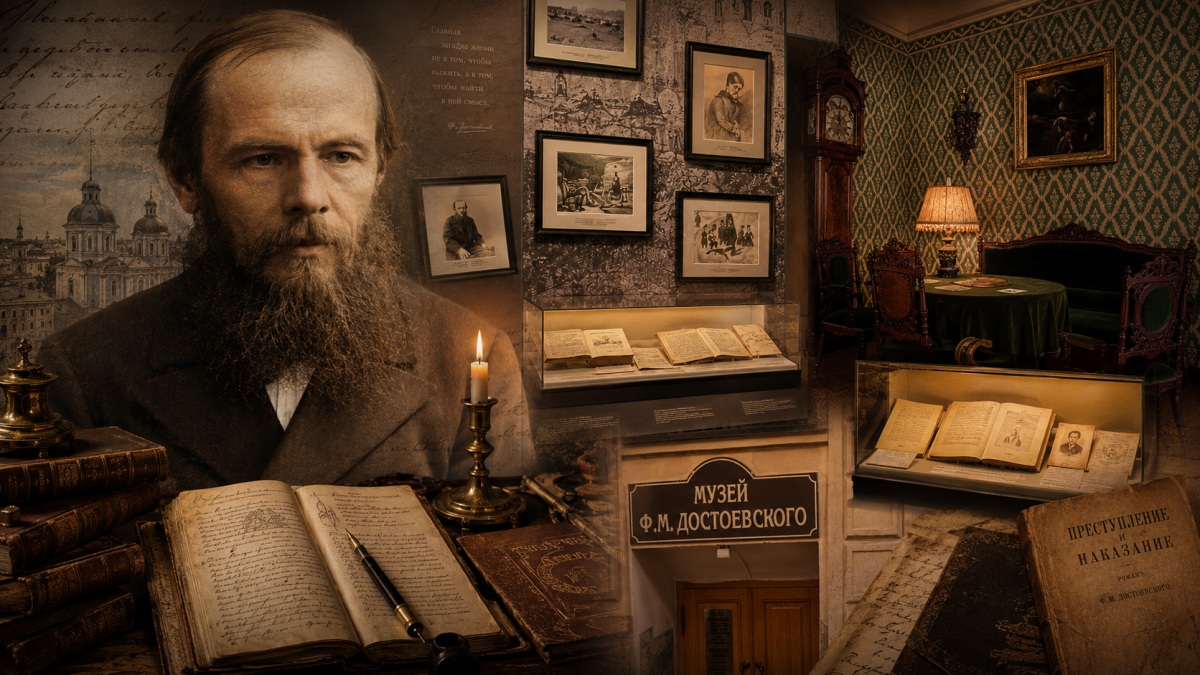
St. Petersburg is a city where it is impossible to simply walk down the street. Here, every house seems to look at you from the past, every courtyard preserves someone’s step, someone’s voice, someone’s anxiety. When I arrived in St. Petersburg, I naturally could not help thinking about Dostoevsky. How could one be in this city and not visit the place where he lived, wrote, suffered, thought, and argued with himself and the world?
I did not walk into the Feodor Dostoevsky Museum as an ordinary tourist. Perhaps because Dostoevsky has long ceased to be just a name from a textbook. He is one of those writers to whom you return at different periods of your life, reading him anew every time. In your youth, you see drama in him; later, pain; then, the human abyss; and then suddenly you begin to notice the light that is always somewhere close to despair in his work.
From the very first steps downward, a strange feeling arises. It is as though you are not simply entering a museum, but approaching a man whom you have long known through books but never saw alive. In such places, silence sounds different. It is not empty. In it, you hear the creak of the stairs, the rustle of pages, the heavy breathing of a city that once weighed upon Dostoevsky’s characters and upon himself.
I caught myself thinking that in this museum, one does not want to hurry. Here, it is important to look not only at the exhibits, but also at the air between them. At the walls that remember more than they can tell. At the staircase that seems to have preserved the traces of footsteps. At the small details that suddenly become more important than big dates.
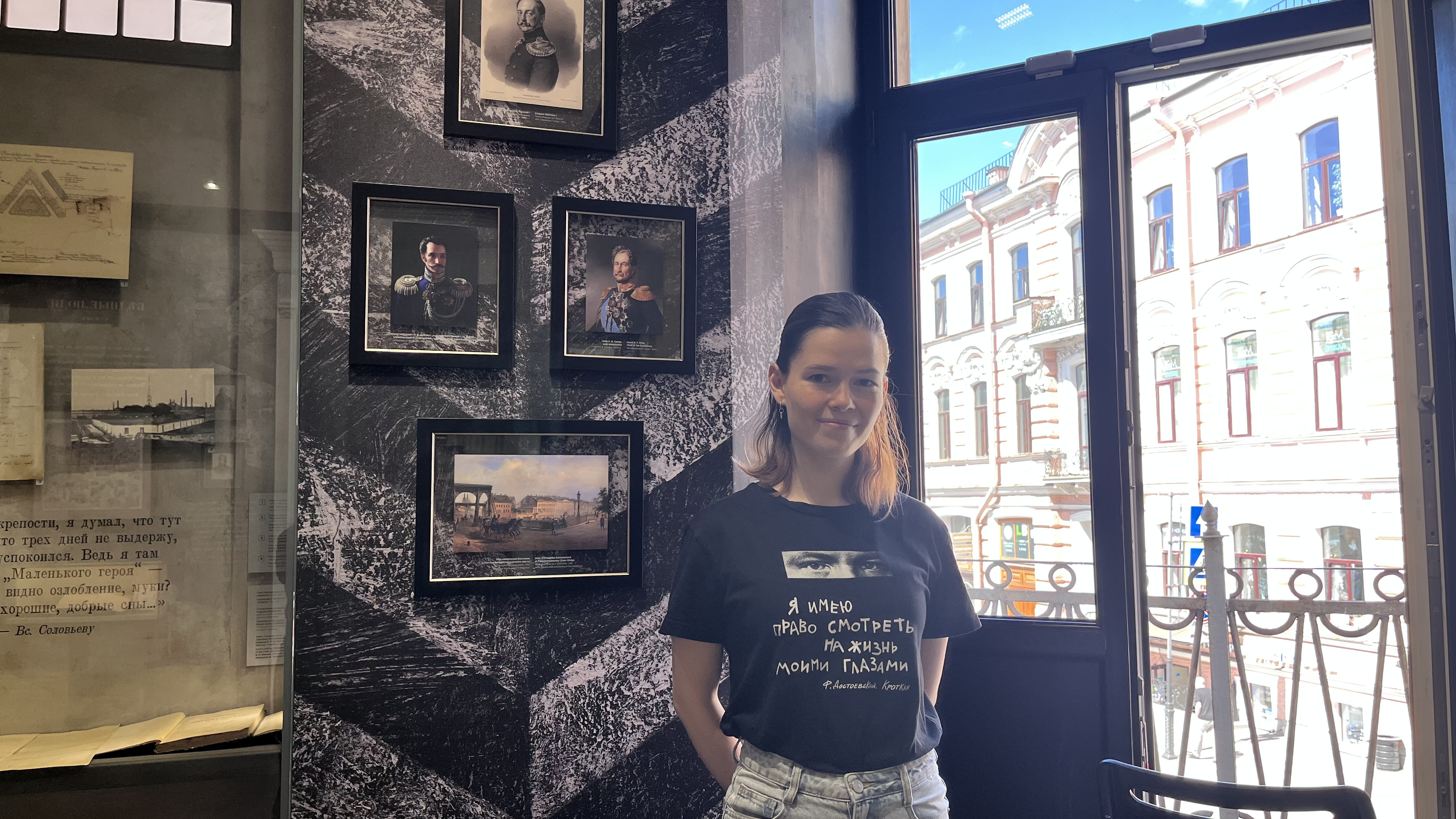
Yet, my true discovery began not only with the museum itself. It began with a conversation with researcher Elena Mikhailovna Khokhlova. Within just a few minutes, it became clear that before me was not merely a museum employee who knows facts and dates. Before me was a person who truly lives and breathes Dostoevsky. She spoke of him as if surrounding her were not display cases and walls, but a living destiny–complex, nervous, tragic, yet surprisingly close.
– Elena Mikhailovna, how long have you been working in this museum?
– I’ve been working here since 2021. This November, it will be five years. When she said this, I thought that judging by her intonation, it seemed as though she had been here much longer. There are people who do not simply come to work, but find their true place. In her voice, that feeling was immediately apparent. I even told her so: your stories make it so clear how much you love Dostoevsky. (She smiled)
– Yes, that’s true.
And with that admission, our conversation began.
– Please, tell us about the history of the museum. When did it open, and how was it created?
– The history is long, complex, but in fact very interesting. It is the history of the entire modern Dostoevsky zone around Vladimirskaya Square. In Soviet times, Dostoevsky was under an unspoken ideological ban due to the antirevolutionary novel The Devils and Lenin’s reaction. Preserving the memory of Dostoevsky back then was achieved with great difficulty. Study hours for Dostoevsky were heavily curtailed, it was impossible to erect monuments, and establishing a museum at the site of his final apartment was out of the question.
Before the museum opened, there were huge communal apartments here, and other people lived in them. On our tours, we say: Dostoevsky left nothing here except the walls. Figuratively speaking, of course, but indeed very little survived. Above all, the staircase.
The museum itself opened on November 13, 1971. This date is also no accident, because the whole world was celebrating the 150th anniversary of Dostoevsky’s birth, and hushing up his name was no longer possible. The museum was created with immense effort: restoring the wallpaper pattern layer by layer, contacting descendants. The descendants provided enormous assistance, donating several items that survived from Dostoevsky’s time.
– What items here are considered the most valuable?
– It depends on your point of view. When temporary exhibitions are organized, especially international ones, they most often send Dostoevsky’s hat and the quill pen with which The Brothers Karamazov was written. It used to be kept in the study; now it has been replaced by another quill from the same period, the same era. Dostoevsky’s authentic quill is currently in Shanghai, as is his hat.
If we speak from an art perspective, there are two paintings here donated by Feodor Mikhailovich’s great-niece. One is in the living room, the other in the dining room. These are 16th-century paintings from the Bassano workshop. And as I told the schoolchildren today, it is a great mystery: how did Hermitage-level paintings end up in the Dostoevsky family?
Another calling card of the museum, besides the hat and quill, is a family spoon with the monogram "F.D." and a handbell. They are located in the dining room behind glass.
– Is the handbell authentic?
– Yes, it is authentic.
At first, this detail seems almost mundane, domestic. One can imagine this handbell being used to call the family to the table. But the real story turned out to be quite different.
– You also mentioned what kind of tea Dostoevsky liked to drink. Could you tell us more about that?
– Easily. Tea simply occupies a very important place in his works. I told the children about this somewhat as a joke. I even said that the handbell behind glass is the very one Dostoevsky rang to call his family to the table. The handbell is indeed authentic, but in reality, he rang it when he was already bedridden and unable to speak. The bell was kept next to his bed, and Dostoevsky would ring it to summon his wife or someone else from the family.
Of course, I didn't tell the children about the role tea plays in Dostoevsky’s works. But it is a very important symbol. In Dostoevsky, all details work.
In his first work, for instance, Makar Devushkin tells Varenka about his life: I live well, I have my own little room, a corner, the air is such that siskins die, but on the other hand, I drink tea, I drink a lot of tea, but I drink it for others, not for myself. What does “for others” mean? If you recall, Makar Devushkin even invents his own way of walking so that his patched soles are not visible. Not because he is cold, but because he is ashamed. And tea becomes a symbol of social inequality and the existential loneliness of the protagonist.
And later in Notes from Underground, the underground man shakes his fist and says: let the whole world perish, as long as I can always have my tea. This is already the rebellion of the hero, a raised fist against the universe. And if you look further into Dostoevsky’s works, certain scenes repeat from novel to novel: when the family sits down at the table and a hot samovar boil in the center, for the reader this is always a sign that paradise on earth has arrived, peace throughout the world. These scenes always follow a scene of scandal.
Dostoevsky is a very “simple” writer in the sense that he has a strategy toward the reader. He will repeat his thought as many times as necessary until we understand it. And so, tea with the family circle and a boiling samovar becomes a very important life symbol for him. From a symbol of social inequality to a raised fist, and then to a sign of universal harmony.
– And why did he put three spoons of sugar in his tea?
– That is a hard-labor habit. That was the kind of tea he loved. Moreover, different sources state things differently. Some write that Anna Grigorievna, when compiling her memoirs late in life, slipped up at times–either saying he drank herbal tea so readers wouldn't associate the habit with hard labor, or conversely, letting it slip that he drank cold, very strong tea. This truly was a hard-labor habit. He loved thick, strong tea, resembling syrup.
I think everything can also be explained very simply. He needed to work through the entire night. He was, of course, a writer of the night, but working at night is still hard, even for people used to staying awake. Therefore, he smoked a lot, and therefore he drank strong, sweet tea to keep himself alert.
At that moment, I realized once again how even Dostoevsky’s everyday habits never remain mere domestic trivia. Tea, sugar, cigarettes, the handbell–everything gradually transforms into a story about a man who lived at the absolute limit.
– Since we are talking about hard labor. Wasn't he scheduled to be executed and then pardoned?
– That is a separate storyline. We can walk over to the exhibition because there is an illustration there where I can tell you everything in detail.
We approached the display case. From that moment on, our conversation ceased to be a mere museum chat and became almost a journey into one of the most terrifying moments of Dostoevsky’s life.
– What happened on December 22, 1849?
– Indeed, a death sentence was handed down. But according to the laws of that time, for the degree of guilt attributed to Dostoevsky, he would have faced a completely different punishment. He was arrested for reading Belinsky’s letter and wishing to circulate it. Given the strictness of Nicholas I’s regime, he would have faced, relatively speaking, two weeks of arrest. And the tsar knew this perfectly well.
But it was an era when the air smelled of revolution. Grand upheavals were sweeping across Europe; the monarchy was being overthrown in France. Nicholas I imagined revolution even in St. Petersburg. He needed to teach a lesson not to the harmless Petrashevists–this society of just over twenty people–but to those who might follow them. Therefore, he commuted the death sentence, of course, replacing it with another punishment, but he decided to carry the execution almost to the very end, stopping it in the final second.
He planned every detail so that it would look like a public execution, a public punishment. He mapped out the Petrashevists’ route to the parade ground. Dostoevsky was deliberately driven past his brother Mikhail’s house as he was taken to the Semyonov Sparser Parade Ground. Today, this is Pionerskaya Square, in front of the Youth Theater.
The entire square was filled with people. A huge black scaffold had been erected, its appearance also dictated by the tsar. Rumors even circulated that funds for building the scaffold were allocated from the tsar’s personal treasury, under the expense item “amusements for the sovereign.” Three posts driven into the ground, soldiers formed into a square. This was genuine stagecraft. When you remember that Nicholas I adored the theater, even viewing himself as an actor and taking lessons from an old French comedy actor, all of this truly looks like his performance.
The Petrashevists were brought to the parade ground and dressed in long burial shrouds. The death-row toilet procedures were performed. A priest walked around with a cross. The sentences were read out. Different terms of hard labor would be announced later, but they were already posted in the newspaper. All of St. Petersburg knew about it, but the Petrashevists themselves did not. They thought they were about to be shot.
They were divided into first, second, and third groups of three. The first trio, led by Petrashevski, was tied to the posts. Everything looked like a real execution: blindfolds on, hoods pulled down over faces, rifles loaded. Seconds remained before the command “fire.”
And in the very last second, the tsar’s aide-de-camp flew onto the parade ground with a supposedly new decree. The execution was stopped. The condemned were returned to the ranks. It was announced: the tsar pardons you, cancels the death sentence, and replaces it with various terms of hard labor.
Some lost their minds from the ordeal. Half of the Petrashevists stood completely white-haired from terror. And Dostoevsky stood in the second trio. If it had been a real execution, he would have had no more than three minutes left to live.
I listened and thought: sometimes we pronounce biographical facts too quickly. “Dostoevsky survived a mock execution.” But behind that phrase stands a man who had three minutes left. Three minutes until death. Three minutes in which, surely, an entire lifetime compresses into a single breath.
– Did what he felt in those minutes later reflect in The Idiot?
– Yes. The reader discovers this by reading the novel The Idiot. Prince Myshkin’s monologue about the final moments of a man condemned to death reflects Dostoevsky’s own impressions. Except for one thing. Myshkin says that the anticipation of death can turn into malice, that a person eventually just waits to be shot as quickly as possible. Dostoevsky could not have felt that way.
When he looked at the Vvedensky Church–which has now been demolished–and at the sunlight reflecting off its golden domes, he thought that in three minutes he would somehow merge with them. He was only 27 years old, a very young man. And in this spiritual ecstasy, he turned to Nikolai Sreshnev and said: “We will soon be with Christ.” And Sreshnev, an atheist and the prototype of Nikolai Stavrogin in The Devils, replied with a chuckle: “We will, but as a handful of ash.”
Dostoevsky had no such moods. One cannot say that he resigned himself to the fact that he would soon cease to exist, but the thought that he would become part of Christ sustained him somehow. He could harbor no malice. Therefore, after it was all over, in a letter to his brother Mikhail from the fortress, he wrote the most important thing: life is a miracle, life is the greatest treasure.
– Is that letter here an original?
– It is an exact copy. The original is kept in the archive. Copies like this are made in a special way. A copyist artist is invited, using 19th-century paper, ink, and a quill. The copyist recreates the letter down to the very last stroke, the last comma, the last tear, the last speck of how it looked. It’s not a print, of course, but such a copy deserves special attention in its own right.
After this story, I looked at the museum differently. Every display case seemed not just a piece of biography, but part of a grand inner journey. In Dostoevsky, everything is connected: fear of death, hard labor, faith, illness, duty, love, guilt, compassion. Perhaps that is why he still seems modern. Not because we live in his time, but because his questions still live within us.
– I saw the cigarettes. Did he smoke a lot?
– Yes, a very lot. He could smoke up to fifty cigarettes a night.
– And is there a record by his daughter about his death?
– Yes. His daughter wrote on the cover: “Dad died at a quarter past eight on January 28, 1881.” That date is in the Old Style. Today it is observed on February 9.
There are three versions of Dostoevsky’s death. To children, I tell the most famous version by Anna Grigorievna: as if his pen dropped to the floor, rolled under the bookcase, and Dostoevsky tried to retrieve it. But the study is reconstructed from photographs, and we can see that the bookcase is tall. There was no need to move it to reach a small object. Dostoevsky scholar Igor Volgin drew attention to this. He went into the archives and discovered that on the night of January 26, when Dostoevsky’s attacks began, a police raid was taking place right through the wall against a revolutionary terrorist named Barannikov, Dostoevsky’s neighbor.
This is already the 1880s, the era of Alexander II, assassination attempts, anxiety, The Devils, and The Brothers Karamazov. Barannikov deliberately settled behind the wall from Dostoevsky, likely counting on the notion that his accomplices might get lost amidst the stream of the writer’s visitors. And so a man who had survived his own execution hears the noise of a police raid. Volgin concludes that the psychological shock was quite enough to trigger an attack of such severity.
Moreover, Dostoevsky was extremely sensitive to all attempts on the tsar’s life. After the explosion in the Winter Palace, after shots were fired at the tsar, he would burst into friends' homes and cry: “The tsar has been shot! What now, what era is coming?”
Yet that attack was not yet the final one. There was hope for the formation of a blood clot. And the next day, an argument broke out with his sister over an inheritance. The question of money was always painful for Dostoevsky because he lived in debt all his life. A quarrel, a scandal, and memories of debts triggered an attack of such severity that Dostoevsky lost consciousness. Anna Grigorievna noted that on January 27 he was in the study, a thin stream of blood trickled from the corner of his mouth, his beard crimson with blood. That is when the doctors truly began to sound the alarm.
He was bound to his bed, ice was placed on his throat, and the writer was forbidden to get up or speak. The attacks repeated one after another. On January 28, Anna Grigorievna spent the night in the room next to her husband and around seven in the morning heard: “Anya, I haven't been sleeping for about three hours, thinking it all over, and only now have I realized clearly that I will die today.”
In the afternoon, Dostoevsky asked his wife to divine his future using a book. Unable to speak anymore, he handed her the Gospel and let her open it at random. Anna Grigorievna read: “Do not hold back, for thus it is fitting for us to fulfill all righteousness.” And Dostoevsky replied: “Do you hear, Anya, do not hold back. That means I will die.”
In the evening, at 8:36 PM, he was gone.
The apartment gathered all of reading St. Petersburg. Not only Dostoevsky’s friends, but everyone who wanted to say goodbye to him. The crowd was so large that candles flickered out in the stifling air. Someone noted the exact time of his death, which is why that time is preserved on the desk clock. And 11-year-old Lyuba, stunned, stepped out of the study and wrote with a pencil on the nearest object: “On January 28, 1881, dad died at a quarter past eight.”
In the museum, such words sound different. They cannot be perceived merely as a biographical detail. You stand in the apartment where it happened and suddenly realize that the great writer's death was also deeply human: his wife nearby, the Gospel nearby, children nearby, the city outside the walls, and a crowd of people who came to say farewell.
– I heard that museum staff prepare tea for Dostoevsky every day – strong and sweet, just the way he liked it. Is that truly a museum tradition?
– Yes, roughly so. Candles burn just like an oil lamp. Despite the small number of authentic exhibits, there is still an effect of Dostoevsky’s presence here. Visitors themselves note this. I wrote my master’s thesis dedicated to this museum; I examined the museum-apartment as a museum-metaphor: how to create a sense of authenticity and presence when genuine objects are practically nonexistent.
These are small techniques, subtle touches. Dostoevsky exists not only in objects. He exists in narratives: in the Gospel he reads before dying, in the tea that becomes a symbol of his works, in the stories we tell.
It seems to me that therein lay the true power of this tour. Elena Mikhailovna was not merely showing a museum. She was returning Dostoevsky to his space. Not bronze, not schoolbook-standard, not distant, but alive: with habits, pain, fears, love, debts, gambling passion, illness, and an incredible thirst for life.
– I also wanted to ask about his meeting with Anna Grigorievna. Didn't they have a large age difference?
– Yes, the difference was large. But it was a very happy family, despite the fact that they went through many hardships. It all began with a love story.
Dostoevsky was in a dire situation. In 1864, his first wife died. He was deeply in debt, his beloved brother Mikhail died, and Dostoevsky took on his debts. He faced debtors' prison. In 1865, he signed a contract with the publisher Stellovsky for the novel The Gambler. It is a novel about gambling, about Dostoevsky’s own passions. After all, he had gambled passionately on roulette for a long time. But everyone forgets to mention that he cured himself of this mania only when he began writing The Devils.
The contract for The Gambler was enslaving. The novel had to be delivered by November 1, 1866. If the manuscript was not ready, all rights to Dostoevsky’s works would pass to the publisher Stellovsky. That meant the royalties for any works Dostoevsky might write over the next nine years would go not to him, but to the publisher. It was genuine bondage.
Yet at that time, Raskolnikov was born. Dostoevsky had planned a short novella, a psychological report of a single crime, but became so engrossed that he expanded the concept into a great novel–Crime and Punishment. He almost forgot about The Gambler and caught himself when less than a month remained. How could one write a novel in less than a month?
He was advised to hire a stenographer. Professor Olkhin, one of his friends, ran the first stenography courses and recommended his best student, Anna Grigorievna Snitkina. She came to Dostoevsky on October 4, 1866. And mad work began.
At night, Dostoevsky would pre-plan a chapter. He did not write down the finished text, leaving only notes. Then he dictated to Anna Grigorievna, who recorded it in special shorthand symbols. During transcription, a single symbol could yield an entire phrase, and a single page of shorthand yielded three to four full sheets of text. Such writing speed exceeded normal speed tenfold.
Dostoevsky dictated, Anna Grigorievna transcribed, he managed to make corrections, and in the evening she rewrote the text in a beautiful, legible handwriting. They worked this way for 26 days. Back then, it was a record. In 26 days, the novel The Gambler was ready. Dostoevsky was saved; he remained in literature.
– And when did personal feelings develop between them?
– On the 35th day of their acquaintance, Anna Grigorievna came to Dostoevsky again. She congratulated him on his success and arranged future work. And Dostoevsky said: “I have conceived a new novel. I don’t know how to end it yet. It involves the psychology of a young girl. I need your advice”.
He told her the plot: a middle-aged, sickly artist who has endured much misfortune in life falls in love with a young girl–kind, smart, honest. Her name is Anya, just like Anna Grigorievna. And he asked: “What do you think, could this young girl fall in love with an already middle-aged, unhappy artist? Would that be psychologically true?”
Anna Grigorievna did not understand where he was leading. Then he asked directly: “Imagine that this artist is me. I have just confessed my love to you and asked you to become my wife. What would you answer me?”
And she replied: “I would answer that I love you and will love you all my life.”
Despite the large age difference, it was one of the happiest families in Russian literature. Anna Grigorievna was twenty years old when she worked on The Gambler, and Dostoevsky was forty-five. She was thirty-four years old when he died. She never remarried for the rest of her life. When asked why, she joked: “Who could I marry after Dostoevsky? Perhaps Tolstoy, but he’s already married”.
There was more than wit in that joke. There was fidelity, memory, and an understanding of the scale of the man beside whom she had lived her life.
– What is your favorite Dostoevsky work?
– The novel The Idiot brought me to this museum. I teach a short course dedicated to The Idiot, prepare volunteers for the Dostoevsky Day route, so I always name The Idiot. Although I feel that I love his other works just as much. It’s simply a special novel in my destiny.
This answer explained a lot. One cannot simply come to the Dostoevsky Museum by accident. Everyone has their own entrance: some arrive through Crime and Punishment, some through The Brothers Karamazov, some through The Devils, some through Prince Myshkin. Elena Mikhailovna was brought by The Idiot. And on that day, I was guided by the very sensation of St. Petersburg–anxious, beautiful, cold, and deeply Dostoevskian.
– Wasn't Dostoevsky acquainted with Shokan Ualikhanov?
When I asked this question, I felt a slight thrill myself. In St. Petersburg, inside the Dostoevsky Museum, the name of someone so dear to us Kazakhstanis suddenly appears. And this is no longer just Russian literary history. This is a point of intersection between two cultures, two destinies, two powerful minds.
– Yes, they were acquainted. He was one of his dearest, closest friends. Dostoevsky was serving his exile in Siberia at that time. Fortunately, he met the local intelligentsia. And Ualikhanov was an encyclopedically educated man, an extraordinary ethnographer, and a courageous traveler. Dostoevsky cherished his friendship deeply. We even have a separate display stand dedicated to Ualikhanov in the exhibition. I can show it to you.
– We also have a Dostoevsky Museum in Kazakhstan, in Semey.
– Yes, we do. A colleague of ours travels there frequently. They also have materials about Dostoevsky and Ualikhanov.
– Please, tell us about their friendship.
– The friendship was short-lived because Ualikhanov died young. But it was very bright. Dostoevsky felt his passing with deep bitterness. Ualikhanov was one of the people who sustained Dostoevsky through those difficult six years of service in Siberia. One of his few closest friends of that time.
Dostoevsky’s relationships with some people might fade and then return. For instance, he had a cooling-off period with Nekrasov, but they grew close again late in life. With Ualikhanov, there were no such periods. There was always mutual respect, mutual admiration, and truly a very strong friendship.
For me, this part of the conversation became one of the dearest. Because through it, St. Petersburg suddenly grew closer to Kazakhstan. The Dostoevsky Museum ceased to be merely a place of Russian classics. It became a space where one could also see our history, our memory, our name.
– Can you tell some little-known story from Dostoevsky’s life?
– How little-known it is, I cannot say. One could share a domestic anecdote. But I would rather tell how Dostoevsky failed to meet Tolstoy. That is more interesting and much less known.
This story is connected with Nikolai Strakhov. People love to call him the demon of Dostoevsky’s life, but as for me, he was a petty imp. Strakhov was practically a hanger-on in Leo Tolstoy’s house and an acquaintance of his. Once, Dostoevsky was invited to a lecture by the philosopher Vladimir Solovyov, the prototype of Alyosha Karamazov and one of Dostoevsky’s closest friends. Nikolai Strakhov came to the same lecture, accompanying Leo Tolstoy.
Tolstoy told Strakhov that he did not wish to speak with anyone the entire evening and asked him not to introduce him to anyone. Strakhov agreed.
When Dostoevsky walked over to Strakhov to greet him, Strakhov turned away from him and walked to the far end of the room. Dostoevsky was hurt and offended. He did not understand what in his behavior could have caused such an attitude.
The next day, Strakhov came to Dostoevsky as if nothing had happened. This may have even taken place in this very house. Feodor Mikhailovich asked him: why did you behave that way toward me? How could I have offended, hurt, or insulted you?
Strakhov replied that Leo Tolstoy was with him, and Tolstoy had simply asked not to be introduced to anyone. Then Dostoevsky said: if I had known it was Tolstoy, I certainly wouldn't have approached, but I would have at least looked at him from a distance.
The most interesting thing is that after Dostoevsky’s death, Anna Grigorievna visited Tolstoy in Yasnaya Polyana. It was there that Tolstoy told her: if all the wives of Russian writers were like you, Anna Grigorievna, life would be much easier for us. Anna Grigorievna told him about this incident. Tolstoy read Dostoevsky very attentively all his life, and Dostoevsky also considered Tolstoy one of the foremost writers. They were not personally acquainted, did not correspond, but a constant echo and literary dialogue runs through their works.
When Tolstoy heard this story, he said: if I had known it was Dostoevsky, I would have made an exception for him.
Such is the moment of a mystical missed encounter. They were in the same time, in the same place, knew they were close, but found out about it too late. They could have met, but did not.
I listened to this story and thought that sometimes literature is built not only on encounters, but also on missed encounters. Tolstoy and Dostoevsky stood side by side in Russian culture all their lives, arguing with each other through texts, answering each other through characters, yet in reality they never shook each other’s hands. And in that, too, there is a certain St. Petersburg, almost Dostoevskian mysticism.
As I exited the museum, St. Petersburg already felt a little different. I had entered with thoughts of a great writer, but emerged with the sensation of a living human being. Dostoevsky remained not only in books, not only in portraits, not only in dates. He remained on the staircase, in the tea, in the handbell, in the letter to his brother, in Anna Grigorievna, in his friendship with Shokan, in his missed encounter with Tolstoy, in stories that someone knows how to tell in such a way that the past suddenly begins to breathe right beside you.
And perhaps that is precisely why one should visit such museums. Not simply to see exhibits, but to feel for a few minutes: literature has not died in books. It is still alive in voices, rooms, objects, and human memory.